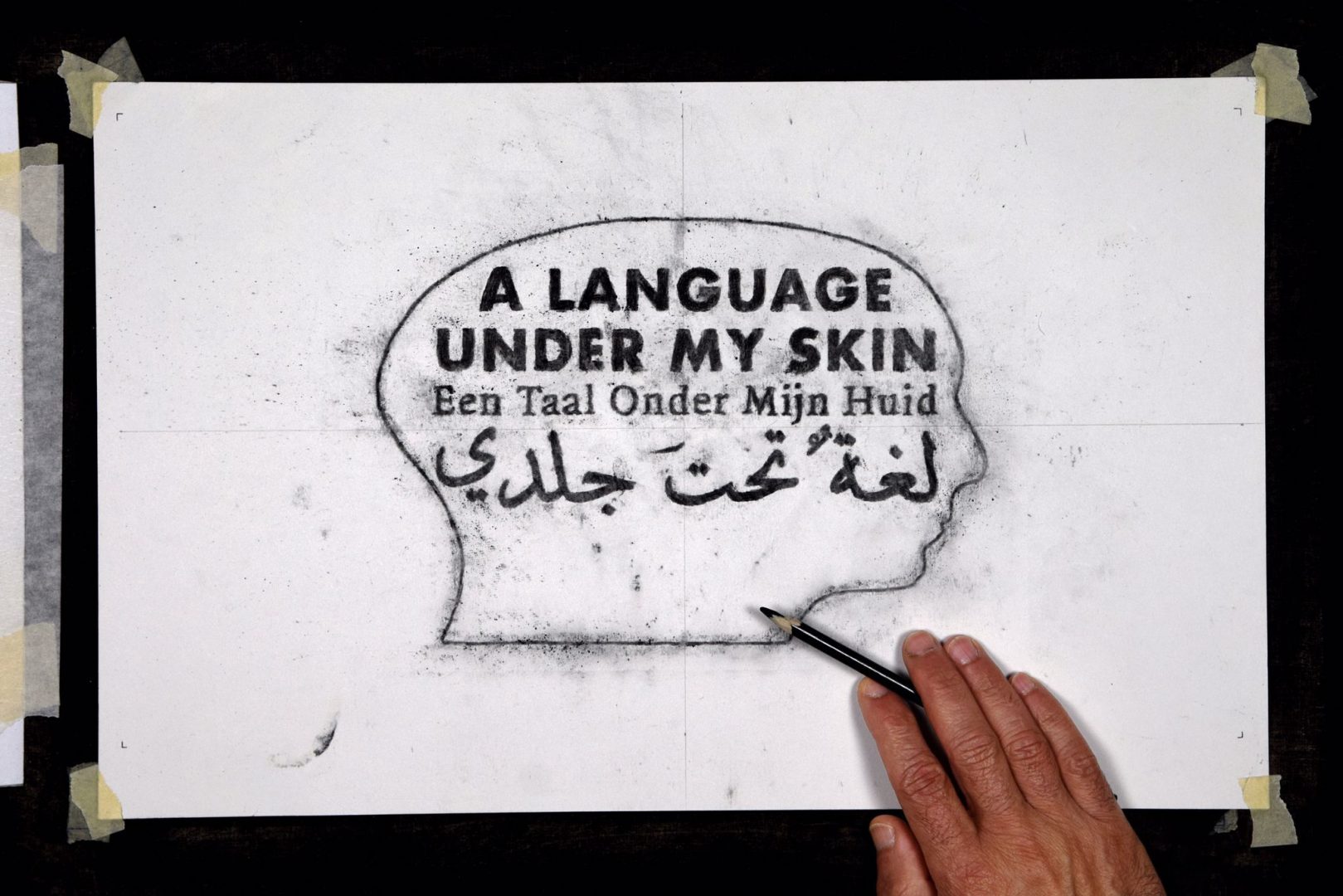
A Language Under My Skin

“I am both a stranger and a native to the same land, to the same mother tongue. This century told us too many times to stay alone, to cut all ties, never to look back, to go and conquer the moon: and this is what I did. This is what I do.” – Etel Adnan

We are born into worlds, environments, and circumstances that are outside of our control—we are born into language. The language(s) we speak impact how we think about, and interact with, our environments. They influence our thought processes, our feelings, how we think about time and space. Questions surrounding language not only touch on linguistics, but they have engaged philosophers, lawyers, religious scholars, cognitive scientists, anthropologists, psychologists, and many others.

So how are we shaped by language? Are languages merely tools for expressing our thoughts, or do they actually shape them? In this solo exhibition, Sadik Kwaish Alfraji explores the complexities inherent in these questions. Encompassed in the animations, large scale drawings, and murals that make up this exhibition, are the questions of what makes a language. Is it the words themselves? Or the images of the words? Is it the alphabet or the sounds of the words or even the physical gestures of expression? Everything together is what shapes and forms a ‘language’. As a storyteller, Alfraji is trying to bring forth one of the faces of language.

A Language Under My Skin features all new work from Alfraji, including an animated film, graffiti murals, and large-scale drawings that transform the exhibition space. Sadik’s drawings and animations echo the notions of the body as a language, a manuscript, a carrier of languages, shapes, meaning. The works in the show give form to, and entangle, the multiplicity of parts that shape language—from the alphabet books we use as children to link sounds with symbols to the complex metaphors and idioms that often resist translation.

The exhibition will also encompass a public program of workshops, film screenings, and talks that will expand on, and provide new points of contact with, the exhibition and its conceptual, narrative, and philosophical underpinnings.

Photography by Pieter Kers.

Curatorial text (pdf)

That Those Beings Be Not Being

Our contemporary moment is saturated with the politics of polarisation and dichotomist thinking—with us- or -against us-, liberal or conservative, right or wrong, all-or-nothing. ​Binary thinking often happens when complex ideas and issues are overly simplified into twofold answers. When instead of embracing multiplicity, we are bound into thinking about, and within, fixed categories that don’t evolve over time or adapt themselves to our constantly changing liquid environments.

This tendency of binary thinking has been affecting societies and structures worldwide, across social, political, economic, and ecological lines. The repercussions of dichotomy have become more critical with the accelerated globalised mobility in recent decades, all while the social fabric is being rendered more mixed and heterogeneous. But how are our environments really affected by the politics and tendencies of polarization? What are the strategies necessary for humans and ecosystems to coexist in the shared spaces that we inhabit?

This exhibition and public program brings into dialogue local and international artists who challenge us to move beyond the trappings of binary thinking, into intervening, overlapping, and intersecting spaces—the inbetween, the not-yet-here, the becoming. Working with video, print, sculpture, performance, and interactive environments, their works engage questions around polyvocality and the socio-political complexities of their environment through humour, storytelling, discourse, and the creation of alter egos and fictional spaces.

The title ‘That Those Beings Be Not Being’ is taken from a chapter in Édouard Glissant’s Poetics of Relation, in which he argues that “we must clamor for the right to opacity for everyone”. For Glissant, ‘opacity’ is an unknowability—an alterity that is unquantifiable, a diversity that exceeds categories of identifiable difference and resists hypervisibility and the drive for total vision.

Photography by Pieter Kers.

Curatorial text (pdf)
About the works (pdf)

He says: I am from there, I am from here,
but I am neither there nor here.
I have two names which meet and part…
I have two languages, but I have long forgotten
which is the language of my dreams.

Mahmoud Darwish

Architecture of Noise

In 2021, the participants of Architectures of Noise were working individually and collectively in art-based research processes. They involve reading sessions, walks, talks, accompanied by architectural and sculptural interventions, performances, workshops, and experiments, especially in the sense of experiri (experience), reason, and resonance in the public and private domains.

During the summer session at W139, artifacts of diverse but interconnected aspects of these genealogies of experience and epistemic architectures are shared with the public. Surveying how these specialized and sometimes also ambiguous instruments (i.e., language, laws) materialities and political concepts crystallized from the past influence future progress.

Architectures of Noise is curated by Evelina Rajca and made possible in collaboration with:

Clara Palli
Pierfrancesco Gava
Arefeh Riahi and Sher Doruff
Ellington Mingus
Susanna Schoenberg
Thomas Hawranke
Lillian Rosa, Gudrun Schoppe in collaboration with Samer Makarem
Evelina Rajca in correspondence with Felipe González and Konrad Bohley
and guests­

More information:
Handout (pdf)
Information about the works (pdf)


POLAR ROOM | WhatDoYouFightFor?

Lillian Rosa, Gudrun Schoppe in collaboration with Samer Makarem

“What empowers people to be the heartbeat of a civil society that drives the change we need in the world?”

This is the key theme of the long term interdisciplinary art work WhatDoYouFightFor? by Lillian Rosa and Gudrun Schoppe. Following up the short documentary (R)EVOLUTION and a series of events in Berlin, they used their collective (digital) Artist in Residency in Amsterdam as the starting point for developing a series of film portraits with citizens from around the world who engage in action around democracy, sustainability and civil rights.

In cooperation with Lebanese activist Samer Makarem and his network engaged in leading a civil alliance for reconstructing and building a civil state without corruption but with civil rights and democracy they are sharing artifacts of the ongoing collective research approach at W139’s Polar Room in the context of their joint (digital) residency.

Photography by Jeroen de Smalen.

Verbógen Verbrijzeld

Verbógen Verbrijzeld (Shattered Scattered) examines how white light can be splintered and bended – how you can become one with matter.

In the solo exhibition by Philip Vermeulen you will get to know his newly developed ‘hyper-sculptures’, which shatter and mechanically scatter white light into thousands pieces of color. The roar of colors, the pinching sound and the wind of the fast spinning machines give you an intense physical experience. Within a meta-composition the works are in constant dialogue with each other, submerging you in the dynamics between human and machine.

Philip Vermeulen is a The Hague-based artist who makes large-scale installations. His installations are  part of his ongoing research in altering psychological states through the manipulation of primary phenomena of light, sound, and movement. Vermeulen creates what he calls ‘hypersculptures’: kinetic sculptures which move at such high speeds they change our perception of the physical properties of these materials.

His work has been shown at locations from museums (Stedelijk Museum Amsterdam, Stedelijk Museum Schiedam, Rijksmuseum Twenthe) to art spaces (W139, Arti et Amicitae), clubs (Berghain Berlin) media festivals (Novas Frequências Rio de Janeiro, Ars Electronica Linz, TodaysArt, CTM Berlin), and outdoors (Into the Great Wide Open, Vlieland). In 2020 Vermeulen’s installation More Moiré² has been nominated for The Volkskrant Visual Art Prize and was also one of the nominee’s for The Golden Calf (in Dutch: Gouden Kalf) in the category of Best Interactive 2020.

This exhibition is made possible in part by: Stroom Den Haag, Mondriaan Fonds, Gemeente Amsterdam, Kickstart Cultuur Fonds en PIP Den Haag.

Under Bat Hill

Under Bat Hill is a group exhibition that imagines the W139 as a glorious cavern in the middle of the city. Isolated from the outside world and its dwellers, this huge space is activated through a daily program of screenings and listening sessions.

At 19:35 on the 22nd of April, 2020, Pope Francis tweeted, [When we are in a state of sin we are like “human bats” who can move about only at night. We find it easier to live in darkness because the light reveals to us what we do not want to see. But then our eyes grow accustomed to darkness and we no longer recognize the light.] His tweet received hundreds of replies including one from @GiveBatsABreak who began, [On the contrary Holy Father, the darkness brings to the bat precisely that which it DOES want to face, not what it doesn’t. Bats are not under the cover of night committing crimes for which it should be ashamed, but providing invaluable services to our ecosystems and communities.] Through a series of further tweets, @GiveBatsABreak pushes beyond the pope’s casual anthropomorphic description, detailing how bats benefit both the environment and the economy.

Under Bat Hill presents a selection of works that too seek to move their subjects beyond casual remit. Subjects that exist in the world outside the cavern under bat hill.

Foto’s door Jeroen de Smalen.

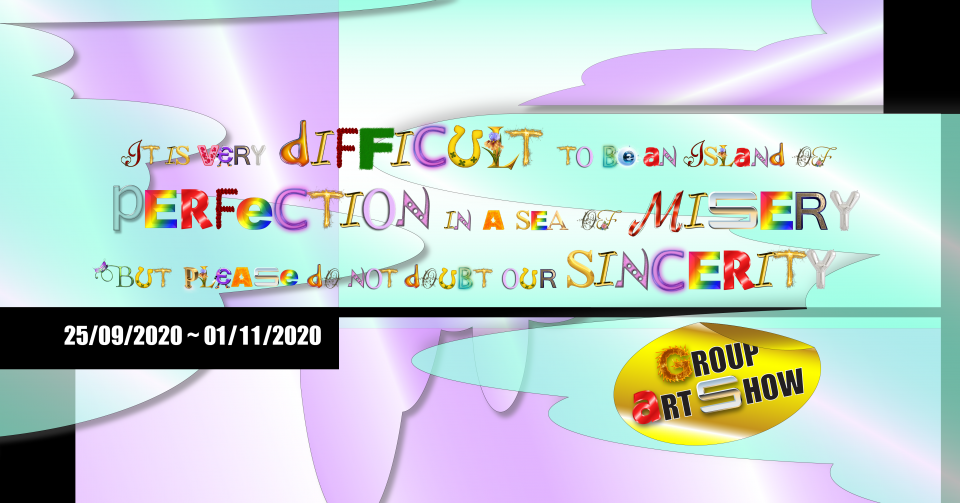
It is very difficult to be an island of misery, but please do not doubt our sincerity

A group art show initiated by Simon Wald-Lasowski for W139, with contributions by Kasper De Vos, Serge Onnen, Ryan Gander, Mire Lee, Aline Bouvy, Julius Heinemann, Maya Brauer & Annabelle Broos, Simon Wald-Lasowski, Bas de Wit, Thomas van Linge, Andrea Éva Győri and Dodi Espinosa.

What is your relationship to excess? Are your rituals of intoxication a means to numb yourself? Or a way to celebrate life against a collective feeling of existential dread? In the ruins of late-stage Capitalism, consumption and hedonism function as a means to escape the body — your body. You are invited to consider the beauty and horror of these daily practices.

Experience an atmosphere of all things fleshy, shiny and morally ambiguous. An abundance of colours, animatronics and visual stimuli that explore themes of digestion, bodily cravings, erotic grotesque nonsense, sex as a matrice of power and the commodification of pleasure. Minimal yet grandiose gestures challenge the monumentality of W139’s backspace with sensory, detailed work; as well as erasing whiteness to reveal hidden traces of past exhibitions.

Situated in the red light district, oozing with debauchery, W139 becomes a space to navigate these flamboyant and decadent practices, with humorous uncanny interventions.

Photography: Konstantin Guz

As far as eye can see

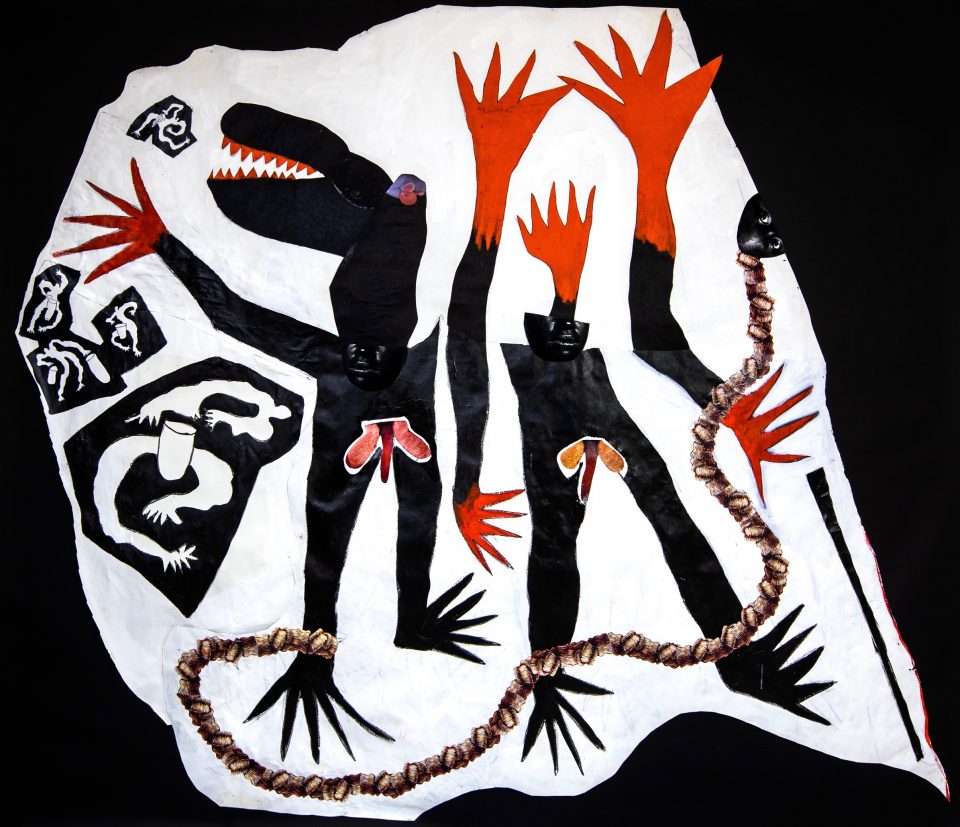
Enter into the world of As far as eye can see, a solo exhibition by Shertise Solano. Dive into the essence of all that exists with her mystical figures, off into a world that is more real than you can ever imagine.

Shertise Solano is a Dutch Caribbean multimedia artist with a background in theatre who lives and works in the Netherlands. Since 2014 she is focused on new forms of expression through experimental visual art, injecting her own DNA into the work — for example by using one image of her face as the starting point of collages — all the while working within a reduced spectrum of three colours: red, white and black.

Photography by Ernst van Deursen.

Market

After a five-month working period at W139, Amsterdam, the project culminated in a three-week exhibition centered on the idea of the market — as a space of exchange, movement, and reconfiguration.

Throughout the residency, the exhibition space remained in flux. The layout was rearranged every three weeks, and eventually every week, responding to ongoing artistic processes and shared use of the space. This continuous transformation fostered cross-contamination between practices, generating conversations, collaborations, and new connections.

Contributors: Chun-Han Chiang, Dave Fransz, Bert Jacobs, Petra Ponte, Nelmarie du Preez & Marcel van den Berg, Tim Breukers, Isabel da Costa, Monique Duurvoort, Thorsten Grahl, Jake, Guy Königstein, Mick La Rock, Mitchell van Ommeren, Moira, Rachel Tokromo, Eunice Weerwind, and Evelyn Agyemang.

Photography by Petra Ponte and Chun-Han Chiang.

ampersands

W139 warmly invites you to ampersands, celebrating our 40-year anniversary with works and performances by:

After Howl, André Avelãs, Koen Bartijn, Marcel van den Berg, Kees Boevé, Caetano Carvalho, Chun-Han Chiang, Aquil Copier, Isabel da Costa, DNK Amsterdam, Jacob Dwyer, Sara Pape García, Sue van Geijn, Sandra Gnjatovic, Esther de Graaf, Laura Grimm, Bert Jacobs + Dave Fransz, Annika Kappner, Judith Kisner, Taisiya Krugovukh + Vasiliy Bogatov, Simon Wald-Lasowski, Axel Linderholm, Pendar Nabipour, Dorine van Meel, Margarita Osipian, Ninna Bohn Pedersen, Eric Peter, Oscar Peters, Michael Petri, Karl Philips, Nans Quétel, Evelina Rajca, Sam Samiee, Helena Sanders, Franziska Schulz + Charlott Weise, Fraser Stewart, Andreas Tscholl, Philip Vermeulen, Dan Walwin.

Initiated by W139, Nadia Benchagra, Marcel van den Berg, Esther de Graaf & Lih-Lan Wong.

For our 40th anniversary, we invited over forty artists/initiators and team members to participate in Ampersands. Together, they have formed the beating heart of W139 for the past 6 years. Since 2014, this ever-growing group, through its individual practices and ambitions, has sharpened and shaped the artistic course of W139.

Ampersands is therefore both a celebration and manifestation of the spirit of W139; an expression of gratitude for all the energy that has been generated for over 40 years. We want to pass this energy on to future generations.

In the upcoming weeks Ampersands will show the strength of unpredictability and bringing together a variety of practices, which are at the core of W139. This is a dynamic presentation and lively public program, which will unfold during the coming seven weeks in concerts, performances, lectures, workshops, (self) publishing, archive work and spontaneous interventions.

Photography by Ernst van Deursen.

Schulz & Weise

A duet by Franziska Schulz and Charlott Weise. Two women artists from the German East found an outlet for their fascination of the early friendship between Siggi & Gerri—visually, emotionally and cerebrally. Schulz & Weise is a soapy ode to friendship; a friendship so intense that it must be unleashed in an artistic involvement.

Ribbons will rise, tilt and twist to become bows.
Schulz and Weise are flirting with the devil.
The eternal feminine is invoked, out of the bottle and with ribbons in the sky.

Special thanks to: Jacob Dwyer (chauffeur), Aileen Klein (fashion design), Ott Metusala (graphic design), Olga Micińska (ribbon assistant), Timna Tomiša (videographer), Dan Walwin (video editor and constructor), Jan van Witteveen (heavy metal) and Van Tetterode Glass Studio.