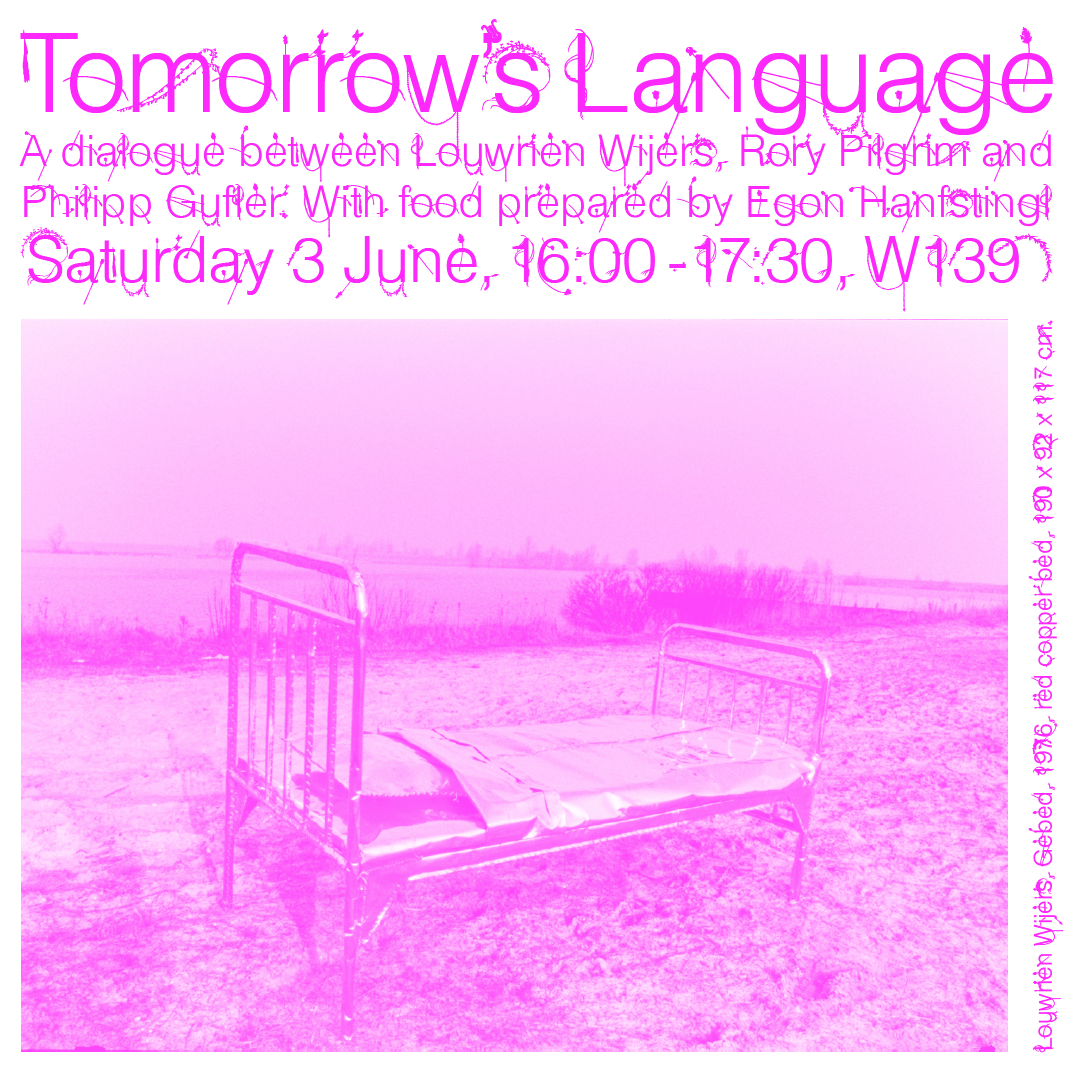
Tomorrow’s Language

A dialogue between Louwrien Wijers, her friend and colleague Rory Pilgrim and exhibition initiator Philipp Gufler.

First they will discuss Louwrien’s metal sculptures and invite the audience to listen to the sound of her brass music box titled ‘She and She’ (1977). Then time will be given to think in silence. How do we sculpt ourselves into the future? What is the relationship between the material and the immaterial? Egon Hanfstingl, chef and long-term collaborator of Louwrien, will then hand out yogurt curd with saffron and honey. Egon asks you to delve into what food does for your brain, for your health and for your life? ‘Food is the Future’ is his slogan, food determines tomorrow for you. Louwrien, Rory and Philipp will discuss the meaning of nutrition too and then move on to the meaning of intergenerational friendships between artists, the importance of learning from each other, especially by talking and finding the words together that are important for the future: Tomorrow’s Language, the words that help us make tomorrow. As the mediator, Rory will articulate what is happening and provide context to the discussion.

The dialogue will be in English.

Louwrien Wijers, born January 26 1941. Afraid of being indoctrinated, Louwrien avoided going to art school and instead wrote about art from 14 years of age and visited as many artists as possible in their studios. She started to make art in 1970. 40 woorden (1970-1971) is featured in the permanent Stedelijk Museum show. She continues to make, think, and write about art and artists today.

Rory Pilgrim works in a wide range of media including songwriting, composing music, film, music video, text, drawing and live performances. Centred on emancipatory concerns, Pilgrim aims to challenge the nature of how we come together, speak, listen and strive for social change through sharing and voicing personal experience. Strongly influenced by the origins of activist, feminist and socially engaged art, Pilgrim works with others through different methods of dialogue, collaboration and workshops. 

Philipp Gufler spans various media in his practice, including silkscreen prints on fabric and mirrors, artist books, performances, and video installations. Since 2013 he has been an active member of the archive Forum Queeres Archiv München.

Photography by Elodie Vreeburg.

Visual identity by Jacob Hoving.
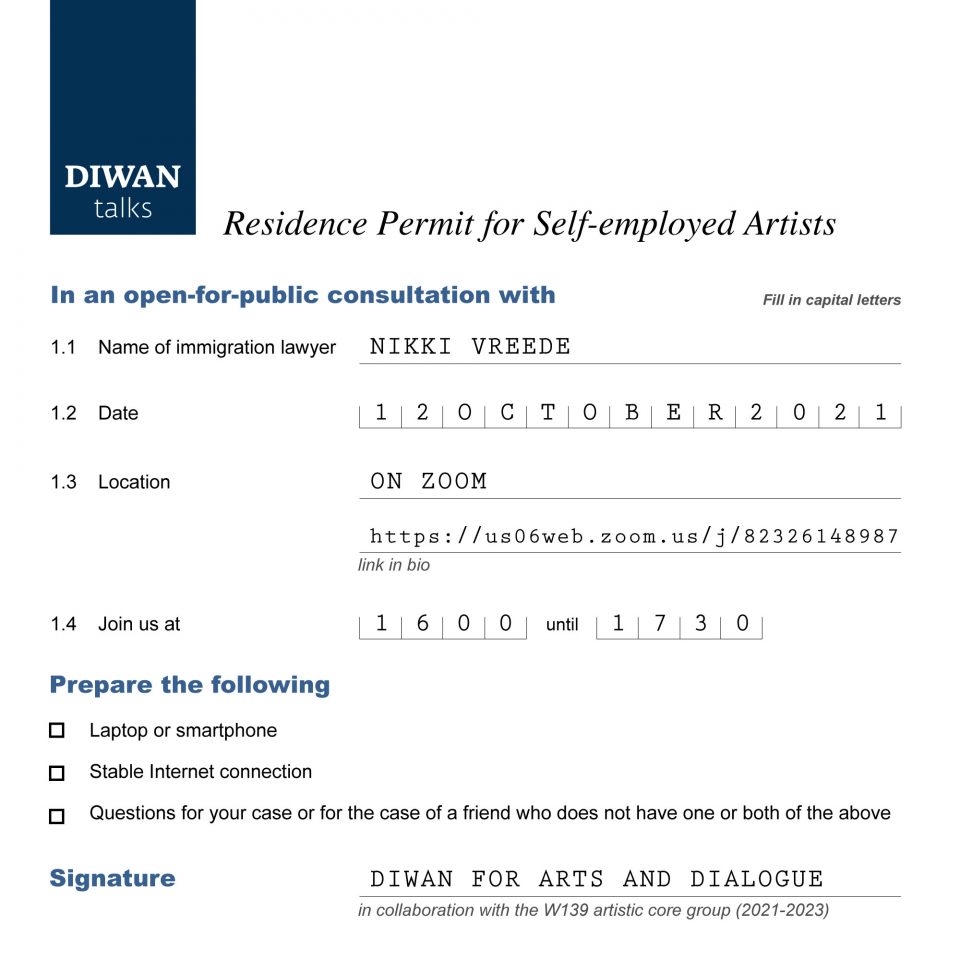
DIWAN talks: Residence Permit for Self-employed Artists

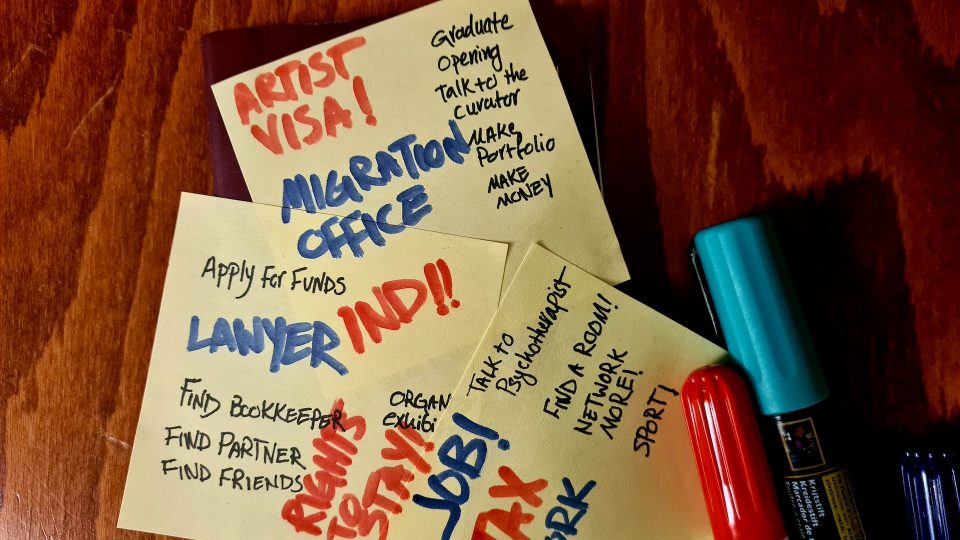
DIWAN for Arts and Dialogue deals with urgencies and pressing questions which the art field, institutions, and practitioners are confronted with. For our third event, we aim to shed light and inform ourselves on the application procedure for acquiring a residence permit for self-employed artists. How do you get a residence permit to work as an artist in the Netherlands? What are the requirements and costs for applying? What are the important points you need to focus on for making a fool-proof application? When do you need to get started with preparing your application?

If you are a non-EU art student who just graduated or if you are almost reaching the end of your search-year (zoekjaar) visa, this session will help you to orientate your next steps towards staying in the Netherlands. DIWAN invites immigration lawyer Nikki Vreede who has experience in assisting non-EU creatives in applying for their artist residence permit. She will share information with us about the procedure towards applying for this specific residence permit: who can apply, what is the paperwork needed, what are the costs, how long does it take to get a response, and what happens after receiving the response, in case of rejection or approval. The session will be divided to include ample time for direct and case-specific questions from the participants.

The event will be moderated by members of DIWAN with the support of the W139 team. You can watch the recording on YouTube here

16:00 – 16:15  Introduction by DIWAN members, laying out the topic
16:15 – 16:45  Nikki Vreede’s presentation
16:45 – 17:00  Break-out rooms
17:00 – 17:30  Public questions from the participants

Nikki Vreede is a lawyer at Everaert Immigration Lawyers in Amsterdam. She mainly assists private individuals, especially in the field of family migration, permanent residence, withdrawal of residence rights, public order issues and residence permits based on humanitarian grounds. Nikki also advises on employment-based immigration. She assists highly skilled migrants and self-employed persons, especially in the creative sector: artists, musicians, dancers, as well as companies that want to become a recognized sponsor to hire highly skilled migrants. Nikki teaches for the Training and Study Centre for the Judiciary on various topics of Immigration Law.

DIWAN for Arts and Dialogue is a platform co-initiated by Fadwa Naamna, Hilda Moucharrafieh, Ehsan Fardjadniya, Margarita Osipian, and Emirhakin, and works in collaboration with the W139 artistic core group (2021-2023).

DIWAN for Arts and Dialogue aims at supporting young contemporary art and design practitioners, especially those in the diaspora, in the development of their projects and artistic practice. The platform’s foundational focus is to facilitate navigating the Dutch art scene for post-graduate artists and curators, and tackle the collective struggles of residency permits, housing, and project funding, amongst others. DIWAN departs from the common experiences of its founders and seeks to stimulate public discursive events and knowledge exchanges that relate to these issues.

DIWAN talks: First Event

DIWAN for Arts and Dialogue aims at supporting young contemporary art and design practitioners, especially those in the diaspora, in the development of their projects and artistic practice. The platform’s foundational focus is to facilitate navigating the Dutch art scene for post-graduate artists and curators, and tackle the collective struggles of residency permits, housing, and project funding, amongst others. DIWAN departs from the common experiences of its founders and seeks to stimulate public discursive events and knowledge exchanges that relate to these issues.

This first DIWAN event is aimed at mapping and understanding the particular urgencies and issues that postgraduate artists and cultural workers confront in the first years after their graduation. This meeting is an invitation for people who are now in this position, or have been through it before, so that we can share these experiences in a collective setting. DIWAN is based on the belief that openly sharing and discussing can be effective tools to confront, deal with, and navigate such challenges. We invite everyone to take part in this online round table and to share their thoughts in this regard.

Throughout these events, we will strive to build a public database of common questions and issues that migrant art practitioners are confronted with, along with references and leads towards resolving them.

Tonight’s event will be co-moderated by Fadwa Naamna and Margarita Osipian.

Joining the conversation will be Hilda Moucharrafieh and Emirhakin. Image and Streaming: Ehsan Fardjadniya and Bob Schoo.

Due to the Covid-19 regulations, the event will be held online.

Note: If you want to just watch and listen to the event, without taking part by sharing your experiences or questions, or if you cannot connect to the Zoom link because of maximum capacity, please follow the W139 YouTube channel and Facebook page for live streaming.

DIWAN is initiated by Fadwa Naamna, Hilda Moucharrafieh, and Ehsan Fardjadniya, in collaboration with Margarita Osipian and Sam Samiee from the W139 artistic core group (2021-2023).

Solidarity Sessions #2

A vestzak-broekzak operation is an unnecessarily complex economic system where money is being pumped around, with most of it ending up back where it came from. How is the cultural sector part of these money flows—from the vest pocket to the pant’s pocket?

In Solidarity Sessions #1, we focused on the overall impact of the corona crisis on cultural workers, independent exhibition spaces, institutions, and the webs of networks around them. For our second session we’ll focus in on the housing and studio rental issues that are coming up for cultural workers, and what that reveals about the larger systemic power structures on which the cultural economy operates. It’s only by seeing the bigger picture that we can understand what we need to do to change.

Join us live via W139’s YouTube channel on Thursday June 11th, at 8 p.m, for an informational, interactive livestream about the current broedplaatsen and housing situation in the Netherlands and its precarity, fragility, and inequality (which the current crisis has made more visible).

We will be joined by cultural workers, lawyers, and representatives of advocacy organizations. During this session, we’ll be sharing:

  • Testimonies by artists and cultural workers who are facing urgent problems with studio/housing spaces.
  • How the crisis is being used as a way to increase rents or evict people from their homes or studios.
  • What rights tenants (either for studios and studio/living spaces) have, or rather do not have, during the covid-19 crisis.
  • How artist-run buildings are organised—in contrast to the broedplaatsen, which are management-led—and how they are supporting cultural workers during this time.
  • The larger picture of how money flows within the cultural sector and how much cultural funding actually goes to paying rent, rather than paying artists and cultural workers.
  • What direct actions we can take towards collective emancipation.

This session is organised by a collaborative effort from Platform Beeldende Kunst and W139, and has been initiated by Margarita Osipian. W139 is virtually hosting the event within the exhibition ‘market’. We hope that in this space we can openly share questions, concerns, and fears, and stand in stronger solidarity with one another. The audience can participate in the Q+A period through the YouTube chat.

Speakers will include Jeremy Bierbach from Franssen Advocaten who are experts in immigration law, Platform BK who are representing artists and cultural organisations and are lobbying on a local and national level, artist Tatjana Macić who has been doing research about studio policy for Platform BK, and Remco Osório Lobato from Stroom Den Haag.

Contributing cultural workers include tenants from WOW Amsterdam, Square 28, and Lood6, Ehsan Fardjadniya, and Julia Sokolnicka. Elke Uitentuis and Alhady will be joining to speak about the struggle for basic rights by refugee collective Wij Zijn Hier.

Solidarity Sessions #1

What issues are cultural workers, independent exhibition spaces, institutions, and the webs of networks around them, facing in light of the corona-crisis? Join us live via W139’s YouTube channel on Wednesday May 6th, at 8pm, for an info session and open conversation on the corona-crisis and the cultural sector for artists and cultural workers.

This is an informational, interactive livestream about the current situation in the Netherlands in regards to COVID-19 and its impact on the art and cultural sector. We will be joined by several cultural workers, a lawyer, and a union representative. During this session, we’ll be discussing:

  • Personal stories about the situations cultural workers are facing now. What work is being done in living rooms and on balconies around the country?
  • The current situation with governmental support systems, such as TOZO and TOGS, including possible (legal) pitfalls.
  • Obstacles and opportunities for funding for the cultural field, specifically for self-employed cultural workers.
  • What the different organisations and platforms are doing and working on to help you.
  • What the (near) future might look like and how we can plan for it.

This session is organised by a collaborative effort from Platform BK, Salwa Foundation, and W139, and has been initiated by Margarita Osipian. W139 is virtually hosting the event. In this art space a group of makers are working through this lock down and will set up a virtual environment where we can come together in their exhibition market. We hope that in this space we can openly share questions, concerns, and fears, and stand in stronger solidarity with one another. Speakers will include Jeremy Bierbach from Franssen Advocaten who are experts in immigration law, and Platform BK and Kunstenbond who are representing cultural workers and organisations and are lobbying on a local and national level. Contributing cultural workers include Eshan Fardjadniya, Alina Lupu, Julia Sokolnicka, and Yara Said. More speakers to be confirmed.

We want to share all the available information out there with you, we feel it is important to hear cultural workers’ voices in this session, and we want to ask you to send in your questions to us, so we can take them into account in preparing our answers for you. You can email us until 5pm on May 5th with your questions at info@w139.nl