after afterlives: film screening and talk programme

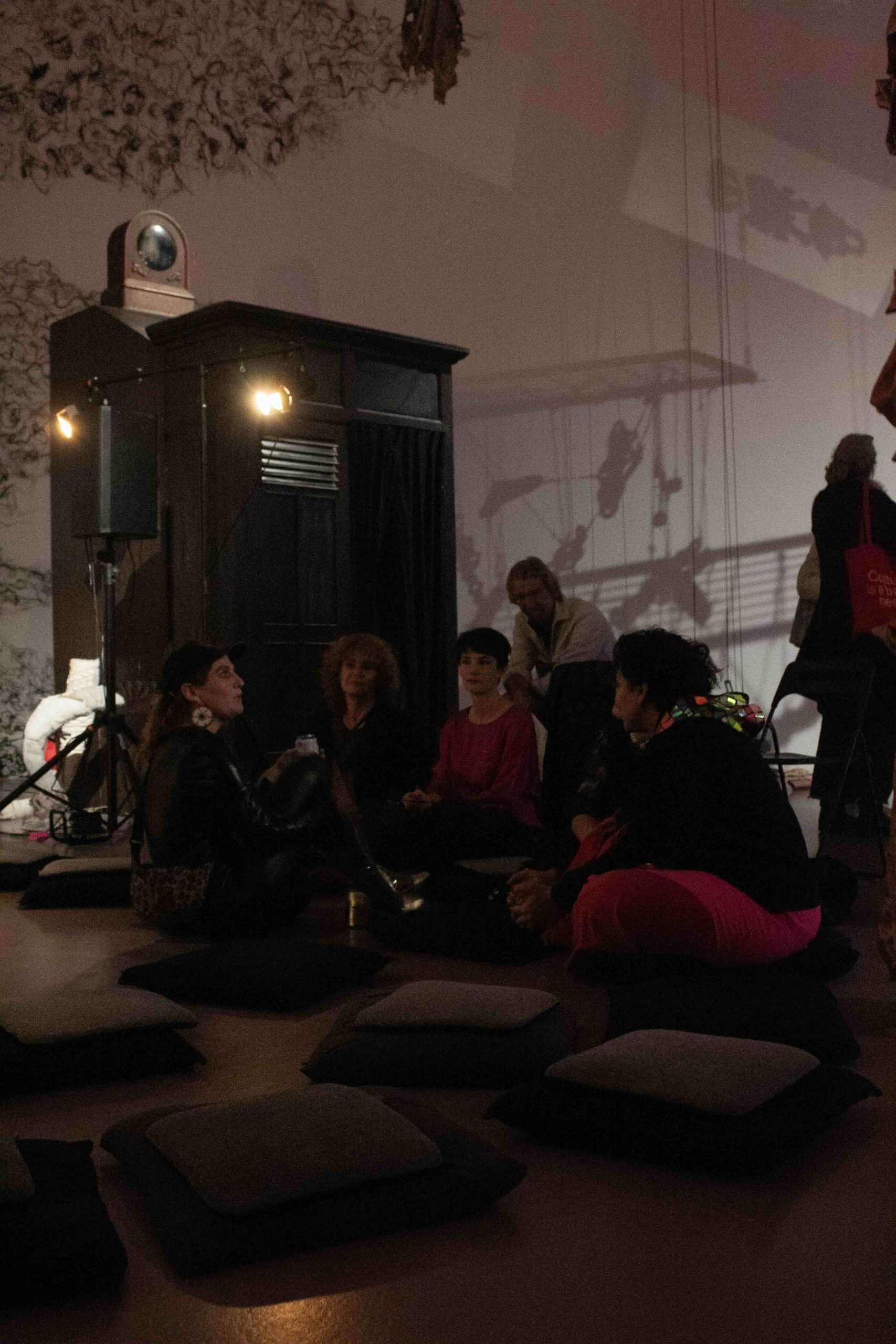
What does the ground unleash when it is denied keeping what it holds? How does soil get implicated in the carrying of catastrophe? And how does continuous excavation for artefacts reveal an obsession to erase history in order to create a new one? Against this erasure, how have material knowledges of burning, plastering, and burying offered different approaches to the ground—one where land and flesh are bound together in a rhythm of constant transformation? These are some of the questions we’ll be engaging with during this program, which will expand on the works of Areej Ashhab and Ola Hassanain, in the flour, water, soil exhibition, and bring in the work of Dina Mimi, to open up a conversation about the artefact as witness, the erasure of history through excavation, the objects and topologies of repair, and the relationship of people to their material environments. 

Areej will be sharing excerpts from her film Lime Through the Elements, and connecting them to her new installation, The Ground Keeps What it Holds, commissioned for this exhibition.  The work engages ancient burial practices in Palestine and the aftermath of their settler-colonial excavation. Through field research, experimentation, and collective labor, the film revisits the lost practice of lime making in Palestine and its elemental journey back to limestone as a reflection on return—what survives erasure and elimination.

We will also be screening Dina Mimi’s short film The Eyes That Never See, which narrates the story of Ram(z)i, a lonely working class man who died twice. Ram(z)i was renamed as soon as his first body died, to die again in Jerusalem, under the dusty ground while digging for artefacts from a 6,000 year-old ancient city. Just like in Areej’s work, Dina’s film exposes the obsessions of a settler state that continuously excavates, digging deep into the ground, to find artefacts in order to create new histories.  

Ola will present her spatial installation for the exhibition, Water Collection Points, and contextualise it within her ongoing project Tell The Water What The Clay Kept Secret. The work uses water collection points across the exhibition space to make visible the efforts to repair the environment that emerge at the onset of catastrophes. Framed as a site for the ‘ecology of repair’, Ola examines this collective effort to deal with crisis by highlighting roles within communities—especially those living near water—where watching and listening emerge as spatial practices shaped by environmental and political rupture. 

The films and talks will be followed by a conversation between Ola, Dina, and Areej, moderated by Margarita Osipian—interweaving their individual works and the stories that unfold through them.

Ticket: €7,50
Student and solidarity ticket: €5

Buy your tickets via Eventbrite.

Areej Ashhab is an artist and researcher whose work addresses material heritage loss, more-than-human ecologies, and land politics. Areej’s practice spans material experimentation, writing, and film, and often unfolds collectively through walks, workshops, and shared meals. She is the co-founder of Al-Block, documenting lost narratives of the Palestinian landscape through collective walking, and Al-Wah’at, a translocal collective countering anthropocentric and colonial narratives around arid lands and futures. In her recent project A Hand of Fire and Stone, she traced abandoned lime pits in Palestine, built a lime kiln prototype in Bethlehem, and activated this lost architecture through fire, songs, and meals; following the elemental cycle of lime from stone, to paste, and back to stone.

Ola Hassanain is an artist whose work moves through architecture, film, and spatial strategies to reflect on how power becomes visible—and felt—through built environments. Her practice engages with places shaped by climate instability, postcolonial legacies, and displacement, thinking through the politics of inhabiting and how ecological and social systems shape one another across time. As she notes, “observation summons a form of power”.

Dina Mimi is an artist working in experimental film and moving image, exploring how, and when, bodies become sites of resistance. Often using found footage to explore themes including smuggling and tactics of movement, her work adopts non-linear forms of narration. She approaches editing as an open and exploratory process, experimenting with the opacity of footage—images that are in the act of vanishing.

Looking back at: Wie We Welzijn

Join us for a festive recap of Wie We Welzijn!

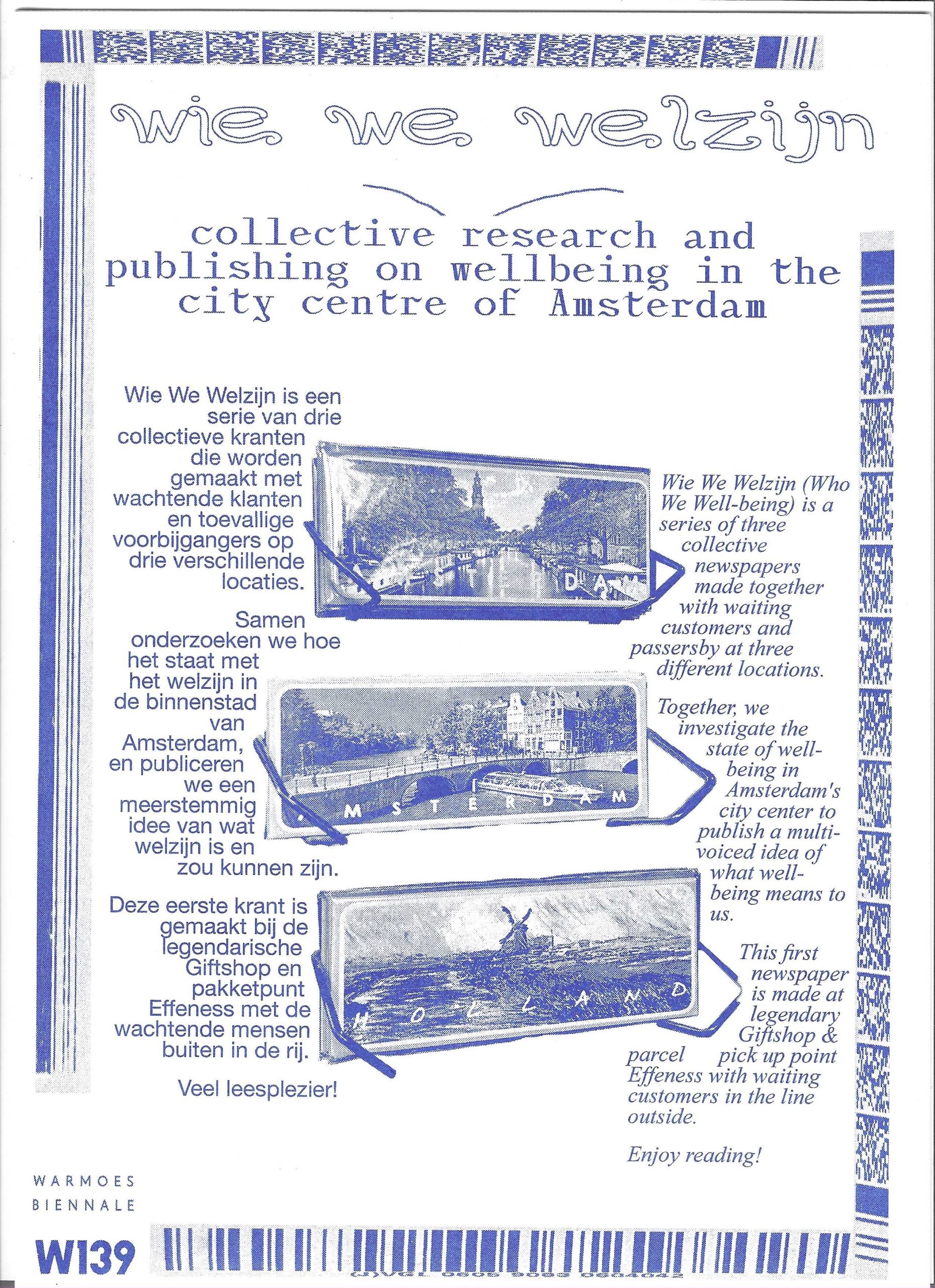
The collective mul-thee-fuhngk-shuh-nl will present three newspapers they initiated over the past months. They will share insights into the making of the publications, and together we will celebrate the conclusion of the project with snacks and drinks.

During the Warmoes Biennale, invited by W139, mul-thee-fuhngk-shuh-nl engaged in conversations about well-being with waiting customers and people passing by. What is the state of well-being in Amsterdam’s city center, and what factors shape it? Stories, perspectives, and ideas were collected and compiled into a series of three free newspapers. These were distributed throughout the neighborhood and can be picked up by visitors at all biennale locations.

The first newspaper, about attachment, was compiled on March 7 at gift shop and parcel point Effeness. The second edition, about desire, followed on March 20 at tattoo shop ORDER. The final edition, about searching, was produced on April 4 at Happy Inn Laundromat.

mul-thee-fuhngk-shuh-nl is a fluid collective that explores its surroundings through collaborative making processes and publishes this multiplicity of voices in public space. The composition of the collective changes with each project, depending on who participates.

Melted for Love — Locating Lost Voices

Join us for an evening that moves between research, sonic fiction, and the act of listening as resistance. The programme begins with an artist talk with Emiddio Vasquez of Lower Levant Company, and Diana Policarpo, who will introduce the research behind Bugio Radio Station, focusing on echolocation and other techniques for tracing non-human sound. Together, they discuss how listening can reveal the impact of militarisation and colonial infrastructure on surrounding ecosystems.

The night continues with Every Day Things Disappear by Urok Shirhan, a live performance unfolding as a sonic fiction from the occupied land of ‘ABC’, where words, colours, feelings – and eventually futures – are systematically erased. Told through a fragmented first-person narrator, the work slips between satire and sorrow, tracing the quiet violence of censorship. Blending spoken word with archival murmurs and encrypted song fragments, it conjures a world where remembering becomes a subversive act. Every Day Things Disappear is both lament and code, auto-myth and resistance ritual. It asks how we listen when speech dissolves and what songs take shape in silence. 

This programme is part of the Biennial exhibition Melted for Love at W139, where Lower Levant Company’s and Diana Policarpo’s works are on display. 

Programme
Wednesday 25 February
18:00-20:00

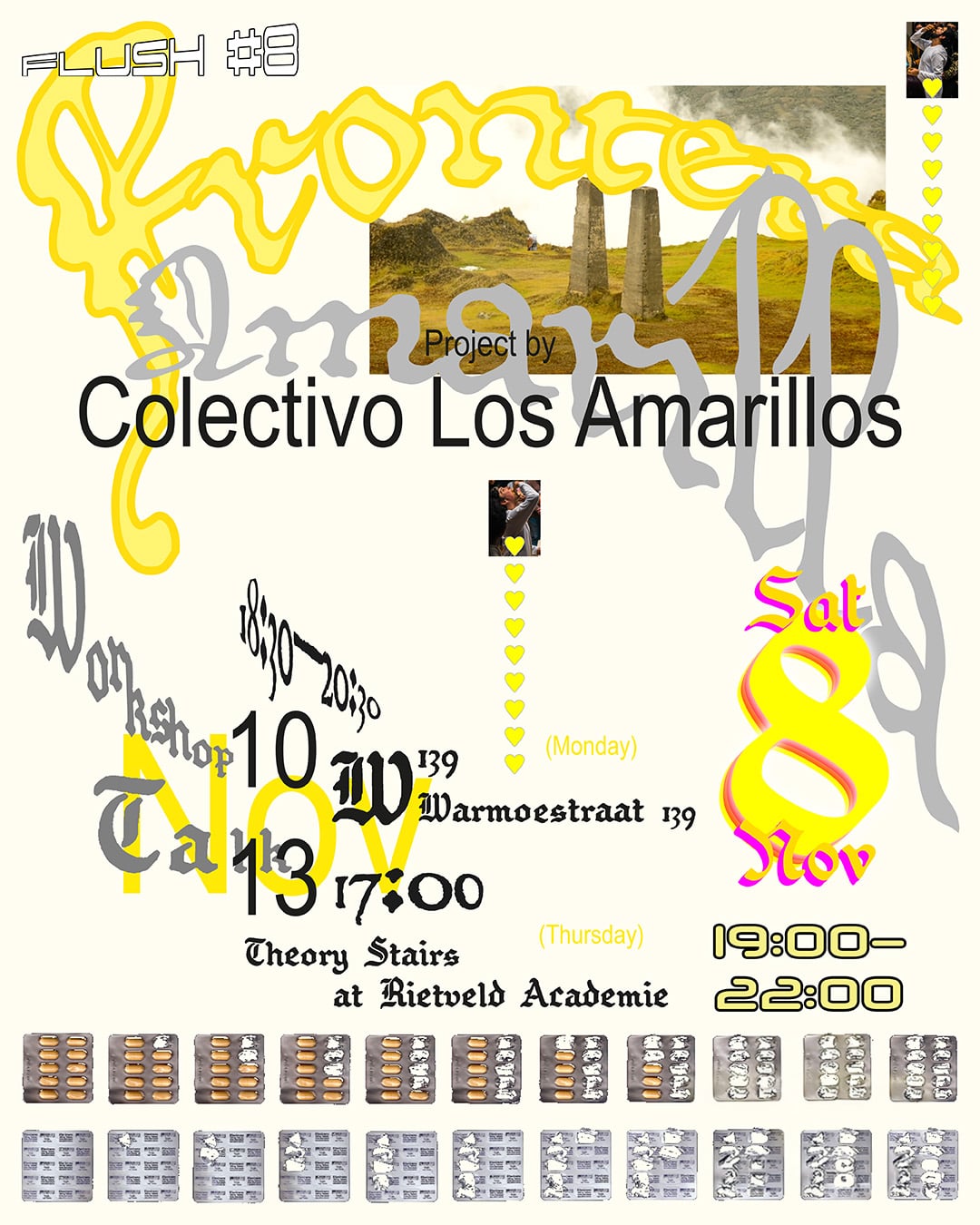
FLUSH #8: Frontera Amarilla

Faced with the tedium of patients who, time and again, return to receive a treatment that remains perpetual; with the side effects endured by some people living with HIV in Latin America due to low-cost medication, the privileges and restrictions in access, the logic of the pharmaceutical market, or the difficulties of migrating with HIV—Los Amarillos (a self-organized artistic collective from Colombia) propose and construct images that embody the demand, the desire, and the sacredness of bodies living with the virus.

The relationship with it becomes language and affective resistance—intimate yet collective, poetic proclamations that invite us to think of HIV not as an illness, but as a political symptom.

It’s about diagnosing utopias, to keep dreaming of a moving revolution. This room does not heal: it burns.

Colectivo Los Amarillos has carried out exhibitions, research, performances, and creative writing laboratories during the autumn of this year in several European cities as part of Frontera Amarilla, and now arrives in Amsterdam to open a space for denunciation, memory, and the celebration of dissident bodies.

Programme
Opening FLUSH #8: FRONTERA AMARILLA (at W139)
— Saturday 8 November, 19:00-22:00

Workshop with Colective Los Amarillos
— Monday 10 November, 18:30-20:30

Artist talk with Colective Los Amarillos (at Rietveld Academie)
— Thursday 13 November, 17:00-19:00

Production: Espacio Estamos Bien
Graphic design: Dun Lee
Text: Lou Vives

With the support of Monstrous Futurities, Romany Dear, and Kyle Tryhorn.

FLUSH is a flourishing collaboration between Espacio Estamos Bien and W139, located in the toilets of W139. FLUSH operates as a flexible form of organizing and creating, enabling various types of collaboration. FLUSH aims to foster inter-local relationships, viewing Amsterdam as a hub for facilitating diverse interactions and building connections that bridge distances. Joyful, friendly and decentralized connections extend beyond the Amsterdam art scene.

Away From The Cognitive

In this roundtable conversation with Dr. Bert Derkx and Mette Sterre, you are invited to reflect on and dissect the Temper Tantrum Bonehouse experience. Together with the audience, we’ll explore what it means to return to the body and step out of the head.

Through conversation, we’ll consider how kinesthetics and movement keep us in touch with our reality, while also offering pathways into other realms. Themes include embodied knowledge, notions of sensing, non-linear forms of creation, and we will challenge the idea that “beauty is in the eye of the beholder.”

Dr. Bert Derkx and Mette Sterre met during her residency at the Rijksakademie van beeldende kunsten, where she investigated the humbling physical force of intuition. Dr. Derkx’s insights into the sensations of the body deeply shaped Mette’s artistic practice—informing both its mental and physical dimensions.

Buy your ticket via the Eventbrite page.

This event will be in English.

Doors — 16:00
Programme — 16:30-18:00

Admission fee: €5

Bert Derkx works as an advisor at the Rijksakademie van beeldende kunsten in Amsterdam, where he acts as a bridge between art and science. Until he fell ill, he worked as a pediatrician and psychoanalyst, with one of his areas of interest being the construction of mind-body dualism in Western biomedical discourse. As an anthropologist and art historian, he is interested in the cultural diversity of perspectives on the body. These aspects also form the basis for his keen interest in the way contemporary artists depict the body in all its facets.

Mette Sterre is a visual artist who investigates the limits and transformative potential of the body. Her work resists categorization, fusing performance, sculpture, body masks, and digital technology into immersive, otherworldly environments that explore the threshold between the organic and the artificial. By entering her work we are cast into the materialisation of her mind processes: a sensorial and embodied experience.

Photos by Jesse Vorswijk

A Slow Conversation on Sustainable Practice

How can artists and designers make their own practice more sustainable for themselves? The current political and ecological climate requires urgent action. We need to move fast, before we run out of resources. But how do we navigate this landscape without burning ourselves down first? Let’s slow down for a moment, get personal, get engaged together, and move from there.    

This workshop is for students and beginning artists, designers and artistic researchers to exchange gained knowledge and ideas about what a sustainable art practice could look like – especially while taking your own needs and resources into account.

For this occasion, Urgent Ecologies (Gerrit Rietveld Academie) also invited several artists, designers, and artistic researchers to join the conversations in small groups. In between the conversations we will do body-awareness exercises by Rosalie Bak (affective, artistic researcher and haptonomic professional). 

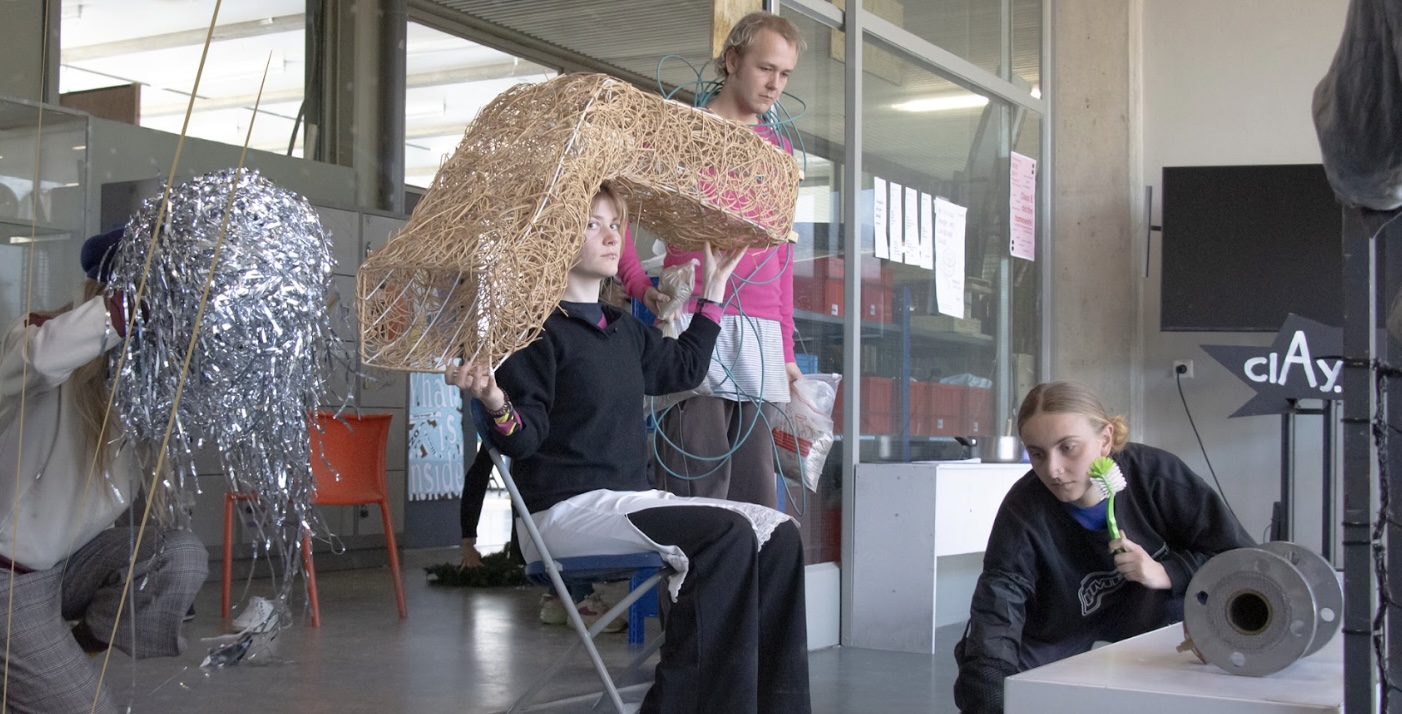
During the workshop we will move between an individual and collective perspective by means of connecting to ourselves, the space we are holding together, and our shared responsibility for the world – we are also part of. We will highlight the importance of the moment itself and create a physical, collective output made of clay that will be part of the exhibition PPP by collective Sunflower Soup at W139.

Walk-in — 13:30
Start workshop— 14:00

Do you want to participate? Reserve your spot on the Eventbrite-page of the event.
Participation is free, but donations are very welcome. There are limited spots available.

Urgent Ecologies is an initiative of the Gerrit Rietveld Academie that focuses on fostering a fundamental ecological and sustainable approach throughout all levels of the academy—within (art) education, institutional activities, and policy. It aims to integrate sustainability as both a topic of discussion and a practice embedded in the day-to-day functioning of the academy.
 Urgent Ecologies provides policy advice and initiates, supports, and highlights various projects, events, and collaborations. Some initiatives have been a pilot project to create a vegan canteen, a community garden on campus (the Garden Department), a fund to encourage the use of sustainable production methods, and a materials library.

Rosalie Bak works at the intersection of affective research, embodiment, and spatial practices, with a strong focus on ecology, art, and somatic care. As an artist and haptonomic professional she is interested in the ambiguous relationship between people and their non/living environments and explores how to make complex predicaments experiential through the body. Her multidisciplinary practice spans from the development of new methodologies and pedagogies to storytelling, writing and the design of workshops, walks and experiences, often working with communities, scientists, (artistic) research groups and the more-than-human world.

Mariana Jurado Rico is an artist and curator working with printing, installation, publishing, radio, and video performance to facilitate points of merger between people. Her works build situations with elements of humor, failure, impatience, and contradiction as tools of resistance. Currently she is working on different collaborative projects that tackle her interest in independent initiatives and self-initiated processes.

Together with Francisca Khamis Giacoman, she founded Espacio Estamos Bien (EEB),  an autonomous non-autonomous space for contradictory things to happen based in Amsterdam that organizes gatherings, publications, exhibitions, and other formats. EEB started plotting the idea of a new space in Amsterdam—not necessarily a physical one—that could provide an affective and supportive context. A space for those who do not belong in the institutional circuit. A space that is always changing, always moving, but always available. EEB is an initiator of conversations and a facilitator of situations. 

Nina van Hartkamp is a multidisciplinary artist, botanical dyer, and story weaver. She graduated from the Gerrit Rietveld Academie in 2020. Her research-based practice unfolds through socially engaged projects that explore the interconnections between humans, non-humans, and the environment.

Working with materials such as plants, microbes, second-hand textiles, audio, video, and performance, Nina’s projects grow out of intimate exchanges with people and places. Her work is guided by questions of belonging, co-existence, and planetary interdependence.

Through site-specific, immersive experiences—including public installations, collective rituals, and community workshops—she invites participants and audiences to reflect on their relationships with each other and the more-than-human world. Her work offers poetic resistance to extractive systems, individualism, capitalism, colonialism, and patriarchy. 

Harriet Rose Morley is a UK-born artist, researcher, and initiator based in the Netherlands since 2018. Her practice explores the gender and labour politics of technical skill within art, design, and architecture, focusing on the working conditions of cultural and technical practitioners. Through her ongoing research Hard Work, Soft Work, she investigates both visible technical skills and undervalued soft skills essential to collective work. A graduate of the Glasgow School of Art and a Dutch MA program, she has led material- and collaboration-based projects, taught across UK and Dutch institutions, and worked with diverse disciplines from architecture to blacksmithing. From 2023–2025, she was Co-Director of Platform BK. In 2025, she will be a Tech Fellow at the Rijksakademie and a resident at Kunsthal Gent.

Amalie ‘Sveske’ Ourø  is a Danish artist who has been living, studying and working in the Netherlands since 2018. Her work, mostly performative and site-specific, can be best described as art-anthropology and is inspired by her curiosity about humanity and reflections of the inner workings of our society. Through her work she actively engages with the audience through acts of play and subversion, inviting them to think critically about diverse societal urgencies within the field of sociology, urbanism, and ecology — encouraging meaningful and sustainable change along the way. Amalie Sveske Ourø is part of the art and garden collectives; The Garden Department (Gerrit Rietveld Academie) and Pleasure Ground.

Joakim Derlow is an artist who specialises in fragmented narratives and spatial comics. His practice brings together objects, found items, drawings and his own performative presence to tell stories of a fragmented nature. These elements thrive on their own, but are meant to be seen in a site specific arrangement which provokes the associations and perspectives of an audience. It is their mending eyes that read out trails or a sequence – inso forming the notion of a narrative.
Ancient West African Principles

A wasi in JawJaw (2008) is a short documentary film recorded during a trip to the interior of Suriname. Rainbow Soulclub members Ebby Addo and Roy Telgt (a.k.a. Totty) are given a ritual washing and treatment against addiction by Mr. Amou, a local Obiya man (medicine man).

After screening the film, spiritual holistic therapist Orsine Walden will dissect the ritual conducted in A wasi in JawJaw, through a lecture on ancient West African principles.    

Orsine Walden is a spiritual healer, poet and holistic therapist applying ancient African principles. Walden descends from the Marron Saamaka freedom fighters, who built their own communities and have resisted slavery not only in Suriname, but also in other regions on the South American continent.

At the age of 17, Walden was initiated by her grandmother Yaadoka into the Winti world of faith. She started her own spiritual holistic therapy practice since age 23.

Buy your ticket on the Eventbrite-page of the event.

Meet Rainbow Soulclub #2

Join us on Saturday, April 12, to meet Rainbow Soulclub members during an informal afternoon featuring various activities, including live painting at the drawing table with Ebby, Abdi, and David, spiritual education in the tent with Mimosa, an informal group discussion on homelessness and housing in Amsterdam with Malika Amghar, a vegan spring roll workshop with Ting, and the classic Free Advice sessions with various Rainbow Soulclub members—get answers to all your life questions from an unexpected perspective.

Live music: Jacques (guitar and vocals)
Food: Soup by George & Perry (vegan)
Guided tour of the space – Tomas, George, Saskia

Malika Amghar has been working for more than 20 years in the social domain of Amsterdam on practical and creative solutions regarding homelessness and housing at De Regenboog Groep. Her focus is on what is possible and what does work: “I find coming up with solutions fascinating and challenging; my passion lies in removing a root cause in the system. I don’t like mopping with the tap running.

Picture by Maarten Nauw / Stedelijk Museum Amsterdam.

Meet Rainbow Soulclub #1

Join us on Saturday, March 22, for an informal afternoon with the Rainbow Soulclub, where you can meet members and take part in a variety of activities. Enjoy live painting at the drawing table with Ebby, Abdi, and David, explore spiritual education in the tent with Mimosa, and join an open discussion with human rights lawyer Eva Bezem. Take part in a vegan spring roll workshop with Ting and experience the classic Free Advice sessions with Rainbow Soulclub members, where you can get answers to life’s big and small questions from a fresh perspective.

Eva Bezem has been a human rights lawyer for many years, specializing in migration law. She is particularly committed to advocating for the legal status of Surinamese former Dutch nationals. In 2024, Eva submitted a residence permit application for 100 ‘former Dutch Surinamese’ individuals.

Picture by Maarten Nauw / Stedelijk Museum Amsterdam.

I Wish I Had a Dark Sea

Artist Brittany Nelson has spent several years researching an archive of letters written between science-fiction writer James Tiptree Jr., who was really a woman named Alice Sheldon, and author Ursula K. Le Guin. Sheldon used a male pen name to get published in the 1970s, and to freely write about her closeted sexuality and desires using alien encounters as metaphors. Tiptree, while in hiding, wrote flirtatious letters to Le Guin, with more than 500 pieces of correspondence exchanged between the two authors in the 1970s before Tiptree was outed as Alice Sheldon. 

In this public talk, Brittany will be in conversation with Julie Phillips, who is currently working on a biography of Ursula K. Le Guin. The two will be in conversation about the correspondence between Le Guin and Tiptree. Brittany Nelson will be joining online. The talk will be moderated by Fiep van Bodegom.

The title of this event is derived from a letter written from Tiptree to Le Guin, which is also part of Brittany’s work in the exhibition, which simply states “I Wish I Had a Dark Sea,”—alluding to Tiptree’s ongoing depression and referencing an Emily Dickinson poem as well as Le Guin’s story The New Atlantis.

Tickets: €7,50
Student price: €5,00

Buy your ticket on the Eventbrite-page of the event.

Julie Phillips is an an American biographer and book critic and the author of James Tiptree, Jr.: The Double Life of Alice B. Sheldon, which received several honours including the National Book Critics Circle Award, the Hugo and Locus Awards, and the Washington State Book Award. Julie is currently working on a biography of Ursula K. Le Guin.

Brittany Nelson explores 19th-century photographic chemistry techniques and science fiction to address themes of loneliness, isolation, and distance within the queer community and its parallels with space exploration.

Fiep van Bodegom is a writer, critic and translator. She is the editor of Extra Extra Magazine and teaches at the Creative Writing department at ArtEZ, University of the Arts. She has published regularly about literature in, amongst others, De Gids, De Groene Amsterdammer, NRC, and De Nederlandse Boekengids. She wrote the foreword for the first Dutch translation of Octavia E. Butler’s novel Kindred (Verbonden, 2022).