flour must be… — learning session 2

Artists and researchers Anna Celda and Saja Amro (Common Ground) will activate their installation in the exhibition with a series of learning sessions. These sessions will use the flour bag as a pedagogical tool for reading, cooking, learning, and reflection.

More information coming soon.

For this event our normal entry ticket prices are applicable. For more info see Contact & Visit.

Reserve your spot via Eventbrite.

Common Ground is a collaborative artistic project by Anna Celda and Saja Amro. Using the dining table and kitchen as learning environments, their projects delve into topics such as female labour, inherited knowledge, and food/famine as a tool for control through different research objects. Their work often materialises in spaces of shared labour, such as workshops or moments spent cooking together, where the conversations and sensory experiences are at the center, sparking reflection and connection with one another.

earthly suns: workshop, gathering, and performance programme

A two-part program that centers the plant-ally Saint-John’s-Wort and the queer poetics it offers. Join artists Sasa Ghanem-Chaney, Jules Davis-Dufayard, and A.E.Z Pinay for an afternoon of queer collective care. In the evening there will be a special gathering with plant offerings, a sonic mediation, and a concert by Queer Choir Amsterdam.

earthly suns is a multidisciplinary research project, developed by Jules Davis-Dufayard and Sasa Ghanem-Chaney, that departs from a shared love towards the plant Saint-John’s-Wort, and a shared love for communal singing. Together they have embarked on a long-term research around this plant-ally since summer 2025, inspired by the queer poetics it offers as it grows powerful and unnoticed between Amsterdam’s pavements. They hope to develop land and body based seasonal practices which are relevant to the current context of late-stage racial capitalism, and which can contribute to the physical, emotional and spiritual nourishment of current social change movements. This research takes form through herbalism, storytelling, trauma-informed care practices, and vocal somatics (Deep Listening). The earthly suns workshop and gathering emerge from their research and collective practices. 

Programme
Workshop: 14:00 – 18:00
Gathering and performance programme: 20:00 – 22:00

Workshop
Jules Davis-Dufayard and Sasa Ghanem-Chaney invite you for an afternoon of queer collective care centering the plant-ally Saint-John’s-Wort (SJW). During this workshop they will share knowledge around what SJW has to offer in terms of physical and mental healing, as well as take inspiration from its resilient growth through Amsterdam’s urban landscape. They will share tools from herbalism, plant symbolism, somatics, collective singing, and vocal meditation working towards community healing and care strategies. Special guest A.E.Z. Pinay will also intervene and invite the group into his grieving practice in the form of choral mourning. In his work he explores the rhythmicality of sobs and sighs, and the melody of moans and laments, as well as the seemingly impossible task to establish a framework that properly allows sorrow to flow.

The workshop is followed by a simple dinner, between 18:00 and 19:00, prepared by maria khatchadourian (only for workshop participants). After the dinner an event will follow with a large scale collective sonic meditation, and a concert by Queer Choir Amsterdam. Separate tickets are available for the evening programme.

The workshop ticket includes the possibility to stay for the evening programme. You can note your participation when you purchase your ticket. 

Evening programme
Join us for an evening of queer joy centering the plant-ally Saint-John’s-Wort (SJW). Sasa and Jules will open the evening with an introduction to their research, offering Saint-John’s-Wort tea and oil for hand massage. The audience will be invited into a collective sonic meditation, followed by a concert by Queer Choir Amsterdam. 

Ticket workshop: €20
Student/solidarity ticket: €15

Ticket evening programme: €7,50
Student/solidarity ticket: €5

Buy your ticket via the Eventbrite page.

Sasa Ghanem-Chaney (French-Algerian, 1993) is an artist, performer, director and facilitator based in Amsterdam since 2017. They work with worldbuilding, interactive installations, collective processes, sound, performance and herbalism. Their practice questions the politics of history-making. What are the invisible frameworks at play in the decision of archiving? Which lores subsist to shape our contemporary perspectives? How can we slow down and listen to the unsung echoes of voices past? Through speculative storytelling, performance, immersive spaces and collective practices, Sasa Ghanem-Chaney questions the making of stories and our political role in the remembrance of minoritized voices.

Website Sasa Ghanem-Chaney

Jules Davis-Dufayard (France, 1991) is an artist/facilitator, and an apprentice of somatics and transformative justice, currently living in a white trans crip/disabled body. They facilitate experiences with/in nature to create internal and collective space for growth and transformation, nurturing healing ways to relate to ourselves, each other, and the webs of relations we are embedded in. At the moment, Jules is fascinated by crip and gut wisdoms, and by practices of herbalism, foraging and eating as everyday and embodied portals to remembering that “the earth isn’t an extension of our bodies, it’s the other way around” (GTDF).

Website Jules Davis-Dufayard

The Queer Choir of Amsterdam is an artistic initiative that promises the creation of a brave space to celebrate unique identities and voices. Through rehearsals and performances, they express their ideas for the futures they desire and the narratives they want to share. In the unification of their voices, they create harmonies, but also distinctively recognize the varied nature of the human voice and hone agency over their voices. Queer Choir also works a lot with soundscapes, improvisation and audience engagement. QC has performed in many venues and events, such as the Oude Kerk, Holland Festival, Buro Stedelijk, Vrankrijk, and the Antwerp Queer Arts Festival.

Website Queer Choir of Amsterdam

A.E.Z. Pinay (he/they) is a queer afropean artist, a film maker, and a performer. A part of his work and research revolves around the black ethos in France and the Afrodiasporic experience in its poetic, political and spiritual expression. Mourning, melancholy, and absurdity are elements that inhabit his creations. Another part of his practice is to cultivate his ability to exist outside of marketing values and learn from forest ecologies. This translates as activities such as resting, doing nothing, lying down in the grass, pray, mourn, cry, observe the living and to open oneself to the possibilities of different worldings. He currently studies and works in Amsterdam and prepares the publication of his first essay with Editions Face cachées.

Instagram A.E.Z. Pinay

Accessibility info
Herbal safety: C
onsumption of Saint-John’s Wort tea or massage oils during the evening is entirely optional. Saint-John’s Wort is a powerful plant, and can weaken the effect of certain medications. Please read this one-page document before consuming Saint-John’s Wort: side effects and contraindications.

Wheelchair access: W139 is spread over two floors. The workshop, dinner, and evening events will all happen on the ground floor, which is wheelchair accessible. Our toilets are located on the first floor, which can only be reached via stairs. The nearest wheelchair accessible public toilets can be found at Krasnapolsky Hotel, 150m away, at the start of the road (Dam Square). For other questions regarding the accessibility of the building, please contact info@w139.nl.

Seating: There will be chairs, benches, or cushions available for everyone, as well as blankets. Feel free to bring your own blanket, stand, move around, and come in and out as your body needs.

Sound: The event will be held in English. There will be no sound amplification for the workshop nor the concert. Audience members will be invited to join in on the singing for some parts of the concert, this is entirely optional. 

Covid/infection safety: We ask everyone to do a covid self-test before entering the event space. There will be self-tests and face-masks available for free/on donation at the entrance of W139. Make sure not to consume food or drinks for 30min before testing, and to allow 15min for your test result to show. Mask wearing is encouraged.

Negative results for such self-tests are unfortunately only ~75% reliable (whilst positive results are ~95% reliable), and all viruses are a risk for immunocompromised folks. Therefore, if you are experiencing any covid/cold/flu symptoms on the day of the event, we will be sorry to miss you, but ask that you stay home and join us at a later public event of the series. Please email margarita@w139.nl to cancel your booking so we can offer your spot to someone else.

Unfortunately, the budget for this event doesn’t allow for translation, sign language interpretation, or live image description. 

This event is part of a series of three programs, which will each have slightly different accessibility. We hope you can join us again in the future. Please email julesdavisdufayard@gmail.com with ‘SJW mail list’ in the email title to be kept informed about future events.

The ticket sales will go towards covid tests, masks, and materials. If the cost is a barrier, please email julesdavisdufayard@gmail.com  
flour must be… — learning session 1

Common Ground welcomes you to the first activation of Flour Must Be Cheap, an installation that becomes a learning space, and a work site. We begin with a question: must flour be cheap? From there, we let it unfold through stories, bodies, knowings, and speculations— these become the curriculum.

Above us, a constellation of collected flour bags. Beneath us, sacks holding the weight of hunger, of resistance, of distance traveled from field to mill to bakery to hand. We’ll lie with that weight, carry it, rearrange it, and feel what it does to the body, how pressure grounds us, how heaviness speaks through us.

Together we’ll move through conversations about food systems, mills and grain, food autonomy, aid, and famine, and the quiet violence of a price that was never really just about the mere cost of flour. Bring your stories, questions, and hands, and join this learning session with Common Ground to experience the contrast of lightness and heaviness of the work Flour Must Be Cheap

For this event our normal entry ticket prices are applicable. For more info see Contact & Visit.

Spots are limited, reserve your spot via Eventbrite.

Common Ground is a collaborative artistic project by Anna Celda and Saja Amro. Using the dining table and kitchen as learning environments, their projects delve into topics such as female labour, inherited knowledge, and food/famine as a tool for control through different research objects. Their work often materialises in spaces of shared labour, such as workshops or moments spent cooking together, where the conversations and sensory experiences are at the center, sparking reflection and connection with one another.

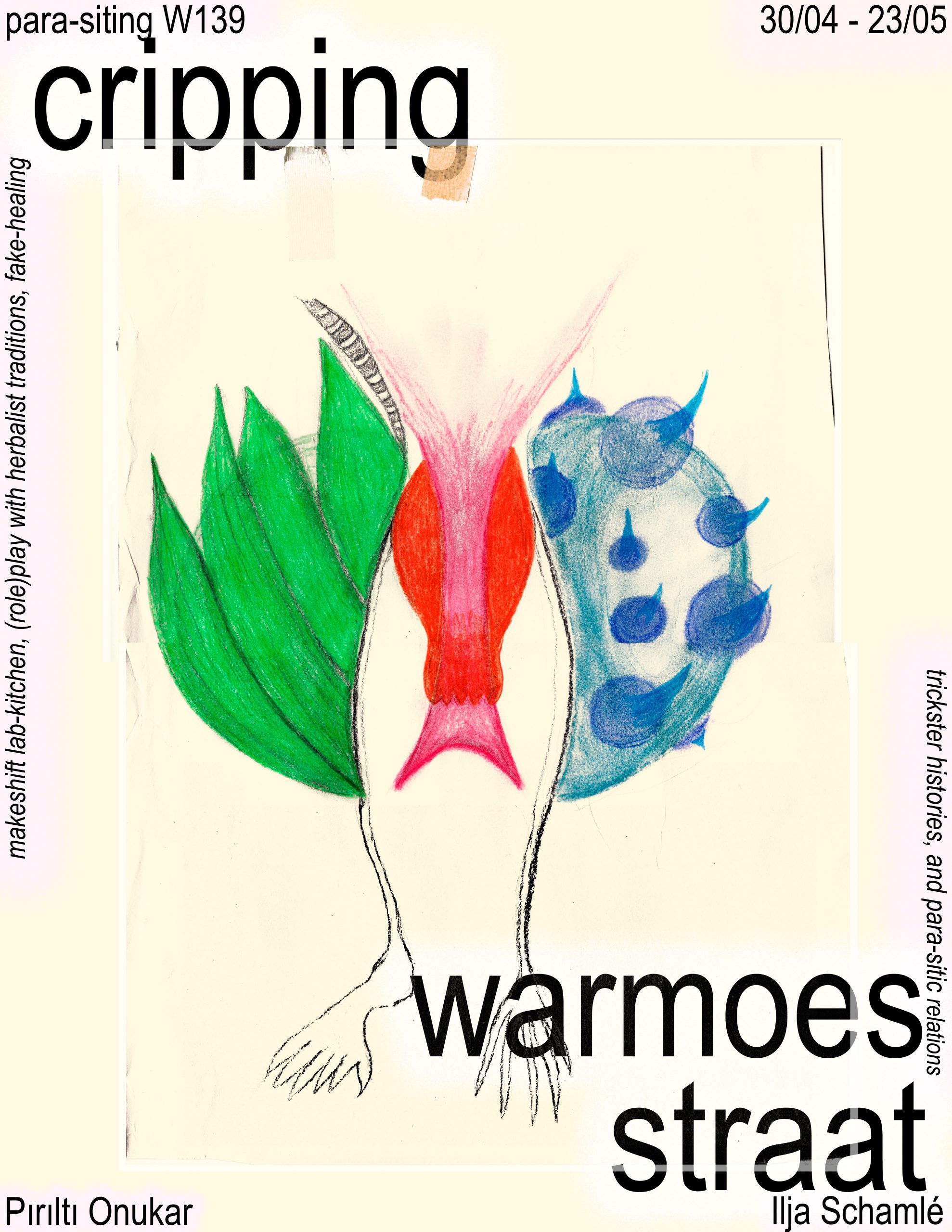
Cripothecary: Herb Processing and Solidarity Workshop

Join us for an open workshop where you get to become part of our lab, making your own concoctions. Inspired by the work of The Solidarity Apothecary (Herbalism and State Violence, Nicole Rose), we will humbly guide you through processing herbs that may be able to help with what makes us sick, anxious and inflamed. 

Our Para-siting space is located on the first floor which can only be reached via a set of stairs. If you are visiting any of our public programme and you have any access needs, please let us know so we may try to accommodate best within our capacity. For this event our normal ticket prices are applicable. For more info see Contact & Visit.

Reserve your spot here!

Pırıltı Onukar has been exploring the themes of belonging and community through experiential process-based and often situated multidisciplinary work, film, participatory performances, translation, farming and foraging. She is currently focusing most of her attention on the artist-run collective GROND Bajesdorp.

Ilja Schamlé is an artist and writer with an amateur herbal and social medicine practice, yet always stuck on when these things tip over from something liberatory into something lonely, esoteric and de-politicised. She is an all round janitor of a community and residency space called Massia.

Crip Healers Reading Group

In these sessions we will read together texts that are guiding Ilja’s and Pırıltı’s  research on herbalism, urbanism, witchcraft, politics of health and crip theory. Together we will try to find how these connect, forming solidarity between our bodies, plants and the city. Guided by the metabolics of Warmoesstraat we will ask what healing means and what makes us sick. No preparatory readings required as we will read and discuss together.

The first session on 2 May will juxtapose theory with speculative fiction. We will read an introductory text to crip theory followed by a selection of passages on the healer character Anyanwu in Octavia E. Butler’s Wild Seed.  

In the second session on 16 May, we focus on inflammation by moving between different theoretical texts on health and politics alongside close readings of herbal recipes by The Solidarity Apothecary. 

The reading groups will be held in the main exhibition space which is wheelchair accessible. For this event our normal ticket prices are applicable. For more info see Contact & Visit.

Our Para-siting space is located on the first floor which can only be reached via a set of stairs. If you are visiting any of our public programme and you have any access needs, please let us know so we may try to accommodate best within our capacity.

Reserve your spot here!

Pırıltı Onukar has been exploring the themes of belonging and community through experiential process-based and often situated multidisciplinary work, film, participatory performances, translation, farming and foraging. She is currently focusing most of her attention on the artist-run collective GROND Bajesdorp.

Ilja Schamlé is an artist and writer with an amateur herbal and social medicine practice, yet always stuck on when these things tip over from something liberatory into something lonely, esoteric and de-politicised. She is an all round janitor of a community and residency space called Massia.

Crip Healers Reading Group

In these sessions we will read together texts that are guiding Ilja’s and Pırıltı’s research on herbalism, urbanism, witchcraft, politics of health and crip theory. Together we will try to find how these connect, forming solidarity between our bodies, plants and the city. Guided by the metabolics of Warmoesstraat we will ask what healing means and what makes us sick. No preparatory readings required as we will read and discuss together.

The first session on 2 May will juxtapose theory with speculative fiction. We will read an introductory text to crip theory followed by a selection of passages on the healer character Anyanwu in Octavia E. Butler’s Wild Seed.  

In the second session on 16 May, we focus on inflammation by moving between different theoretical texts on health and politics alongside close readings of herbal recipes by The Solidarity Apothecary.

The reading groups will be held in the main exhibition space which is wheelchair accessible. For this event our normal ticket prices are applicable. For more info see Contact & Visit.

Our Para-siting space is located on the first floor which can only be reached via a set of stairs. If you are visiting any of our public programme and you have any access needs, please let us know so we may try to accommodate best within our capacity.

Reserve your spot here!

Pırıltı Onukar has been exploring the themes of belonging and community through experiential process-based and often situated multidisciplinary work, film, participatory performances, translation, farming and foraging. She is currently focusing most of her attention on the artist-run collective GROND Bajesdorp.


Ilja Schamlé is an artist and writer with an amateur herbal and social medicine practice, yet always stuck on when these things tip over from something liberatory into something lonely, esoteric and de-politicised. She is an all round janitor of a community and residency space called Massia.

kiln as kin: a day of gathering, firing, cooking

“What flavors place, what place flavors?” Posed by Christina Sharpe in her book Ordinary Notes, this question lingers in the space between land and taste. How does place, how does land, persist even when territory fractures? What stories, histories, and rituals do we carry with us through food? Ingredients, gestures, and tastes become a living archive carried within and through our daily practices of making—kneading, fermenting, grinding, storing, carrying.

Using food as a way to hold and transmit knowledge, during this day of gathering we will come together to activate a newly created tonir-style clay oven and a small stove at Four Siblings. The oven was built during an earlier workshop in May with transdisciplinary artist Tatiana M. Mélo. We will prepare food, cook, and eat together as a way to share knowledge about food systems, forgotten recipes, and lost rituals. We will be joined by Martina Manterola and Carmen Serra, cofounders of colectivo amasijo, an intergenerational feminist collective who work across art, cooking, and land-based pedagogy. They will join us in activating the ovens through their own rituals, practices, and foods. Together with Tatiana we will also be creating small clay structures and sculptures to bake bread inside of.

The residency of colectivo amasijo is part of the Exchanges programme by the Prince Claus Fund, with the support of the Amsterdam City Council.

Ticket: €10
Student and solidarity ticket: €7,50

Buy your tickets via Eventbrite

Location: Four Siblings, President Allendelaan 1, 1064 GW Amsterdam

colectivo amasijo is a feminist collective composed of women from various disciplines and generations, working across art, cooking, and land-based pedagogy. amasijo’s approach centers on collaborative cooking and agriculture as forms of resistance and land regeneration. They are united in their desire to actively reflect on the origin and diversity of our food. Since their formation in 2019 they have been providing a platform for non–dominant voices: the narratives of women close to the land, stories that tell us the real cost of climate change and show us the way towards the regeneration of the land. Through their projects, that can take the form of gatherings, dinners, research, actions, ceremonies, exhibitions, markets, seminars, film, or talks, the collective builds the needed structures to form a community in which taking care of ourselves and taking care of the territory we inhabit is priority. Their practice insists on care, circular knowledge, and embodied time — challenging extractive logics through feminist, decolonial methodologies.

Instagram colectivo amasijo

Tatiana M. Melo is a transdisciplinary artist from Barcelona, living in the countryside of La Garrotxa. She works with clay and ceramics—activating the memory of territory through ritual objects made with stones, ashes, and words gathered from the community. Her practice centers on the transformation of soil into kilns, understood not only as firing tools, but as spaces of encounter, transformation, and ritual. She explores clay as an ancestral material, applying sustainable practices to construction and everyday objects. She has organized workshops and gatherings on collective building, ceramics, and community, collaborating with artists and researchers to rethink the relationship between humans, materials, and the environment.

Instagram Tatiana M. Melo

Four Siblings is a land based art and research project. They come together to create an edible labyrinth in the shape of an artwork in the threshold of the city of Amsterdam. They want to create a sense of belonging to the earth we live on, to the food we eat. They investigate collective ways of generating knowledge and make it as open source as possible.They want to do so in a mutually supportive way—care for our bodies while we care for the land, bring back biodiversity and seed resources, generate new local networks between artists, farmers, permaculturists, and residents, while learning by doing.

Website Four Siblings

kiln as kin: clay oven building workshop

tandoor, tannour, tandir, tonir—an ancient underground clay oven. Carrying different names, the tonir belongs to a family of ovens that are found across Central and South Asia and the MENA regions. The oven has always been a central gathering point. In Armenian cultural tradition it was seen as a symbol of the ‘sun in the ground’—existing as a sacred space in the home for baking bread, cooking, and performing rituals. 

During this workshop we will build a tonir-style clay oven together in the ground at Four Siblings, using clay, soil, and sand from their land. Soil is one of the most abundant materials on earth, yet it remains one of the most overlooked. It is an extraordinary material to build with: it breathes, holds thermal inertia, and connects us directly to the land we inhabit. For thousands of years, our ancestors have worked with soil in many ways: growing food, shaping ceramics, building ovens and kitchens to cook with fire, and constructing homes. In many modern societies, however, soil is often treated as waste. How did we end up living so disconnected from such an abundant material?

We will be guided by ceramist, builder, artisan, teacher, and researcher Tatiana M. Melo. In Tatiana’s practice she transforms soil into kilns, seeing them not only as firing tools but as spaces of encounter, transformation, and ritual. For Tatiana, building with earth is also a gesture of remembrance and care: a way of honoring the knowledge of our ancestors and the land we live on. Gathering around fire becomes a space not only for transforming food, but also for reflecting on the narratives that shape how we live and where we are going

In this day-long workshop, we will learn how to understand soil and use it for different purposes as we learn by doing collectively. We will start with a theoretical explanation about soil, earthen plasters, and wood-fired ovens, followed by the collective building of the tonir-style clay oven. Alongside the larger oven, we will also build a small stove.

These kilns will be activated on June 13th, during kiln as kin: a day of gathering, firing, cooking, where we will prepare food, cook, and eat together as a way to share knowledge about food systems, forgotten recipes, and lost rituals.

We will be working outside, so please dress appropriately for the weather. 

Lunch will be provided. There are only 15 spots available!

The workshop is sold out.  If you want to be added to the waiting list in case someone cancel, please send an email to info@w139.nl.

Ticket: €30
Student and solidarity ticket: €20

Buy your tickets at via Eventbrite.

Location: Four Siblings, President Allendelaan 1, 1064 GW Amsterdam

Tatiana M. Melo is a transdisciplinary artist from Barcelona, living in the countryside of La Garrotxa. She works with clay and ceramics—activating the memory of territory through ritual objects made with stones, ashes, and words gathered from the community. Her practice centers on the transformation of soil into kilns, understood not only as firing tools, but as spaces of encounter, transformation, and ritual. She explores clay as an ancestral material, applying sustainable practices to construction and everyday objects. She has organized workshops and gatherings on collective building, ceramics, and community, collaborating with artists and researchers to rethink the relationship between humans, materials, and the environment.

Four Siblings is a land based art and research project. They come together to create an edible labyrinth in the shape of an artwork in the threshold of the city of Amsterdam. They want to create a sense of belonging to the earth we live on, to the food we eat. They investigate collective ways of generating knowledge and make it as open source as possible. They want to do so in a mutually supportive way—care for our bodies while we care for the land, bring back biodiversity and seed resources, generate new local networks between artists, farmers, permaculturists, and residents, while learning by doing.

Warmoes Biënnale: tattooshop x verlangen

During the Warmoes Biënnale, mul-thee-fuhngk-shuh-nl will talk to waiting customers and passers-by about well-being. Stories, perspectives, and ideas on this topic will be collected during three pop-up editorial offices at the Effeness parcel point, Happy Inn Laundromat, and ORDER tattoo shop. At each location, they will address a different subtopic of well-being: pakketpunt x hechten, tattooshop x verlangen & wasserette x zoektocht. The findings will be published in three publications, which will be available in the participating pavilions of the Warmoes Biennale.

tattooshop x verlangen

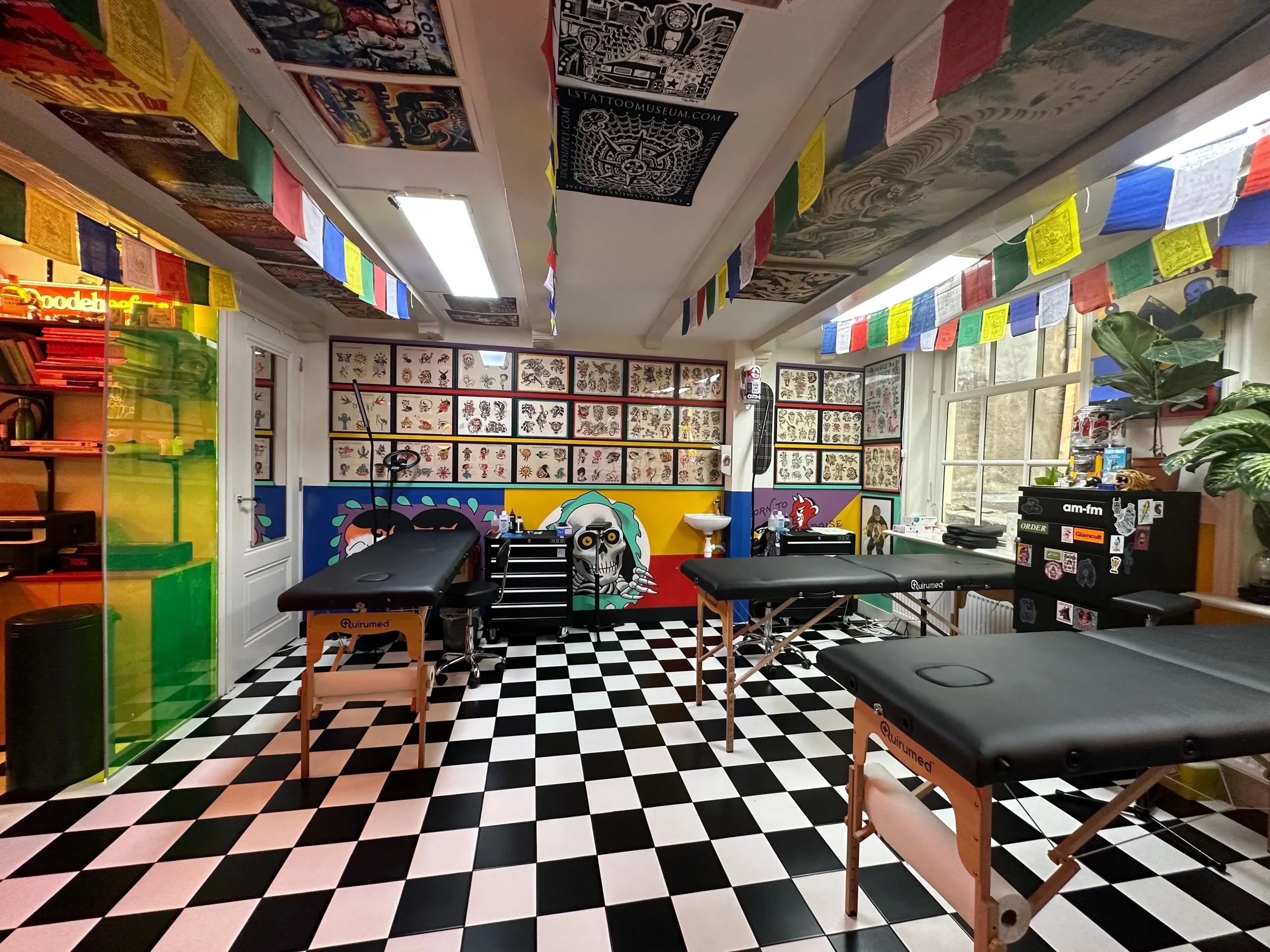
The second editorial office of mul-thee-fuhngk-shuh-nl is setting up shop for a day at ORDER tattoo shop: a place where people sit for long periods of time or wait for their turn. This is a good moment to discuss what gives life meaning in a post-capitalist system. We collect definitions of meaning, investigate whether people consider themselves meaningful, and where the desire for meaning comes from. We collect stories, thoughts, wishes, the feeling of meaning in Warmoesstraat, tips and tricks for meaning, classified ads, and historical context about the welfare economy.

Mul-thee-fuhngk-shuh-nl is a collective that creates dynamic installations with a crossover between workshops, public space installations, and happenings through interactions with others. Their projects share a common focus on engaging with the environment and fostering exchanges with a diverse audience, generating new imaginaries around the contexts the projects take place in.

Warmoes Biënnale: pakketpunt x hechten

During the Warmoes Biënnale, mul-thee-fuhngk-shuh-nl will talk to waiting customers and passers-by about well-being. Stories, perspectives, and ideas on this topic will be collected during three pop-up editorial offices at the Effeness parcel point, Happy Inn Laundromat, and ORDER tattoo shop. At each location, they will address a different subtopic of well-being: pakketpunt x hechten, tattooshop x verlangen & wasserette x zoektocht. The findings will be published in three publications, which will be available in the participating pavilions of the Warmoes Biennale.

pakketpunt x hechten

The first editorial office for the three publications of Wie we welzijn is located at parcel point Giftshop Effeness. Here, mul-thee-fuhngk-shuh-nl will discuss materialistic satisfaction in relation to Warmoesstraat as a centuries-old center for trade. While you wait for your parcel, there is just enough time for self-reflection, an existential crisis, or a mental breakdown. What did I order again?

In addition to collecting the contents of packages, we ask questions such as: do you have what you want? Where does this desire for more come from? How do we position ourselves in a world that revolves around accumulating wealth and possessions? How do your possessions possess you? We collect reviews, stories, (un)realistic classified ads for (more) stuff, the best object you can own.

Mul-thee-fuhngk-shuh-nl is a collective that creates dynamic installations with a crossover between workshops, public space installations, and happenings through interactions with others. Their projects share a common focus on engaging with the environment and fostering exchanges with a diverse audience, generating new imaginaries around the contexts the projects take place in.