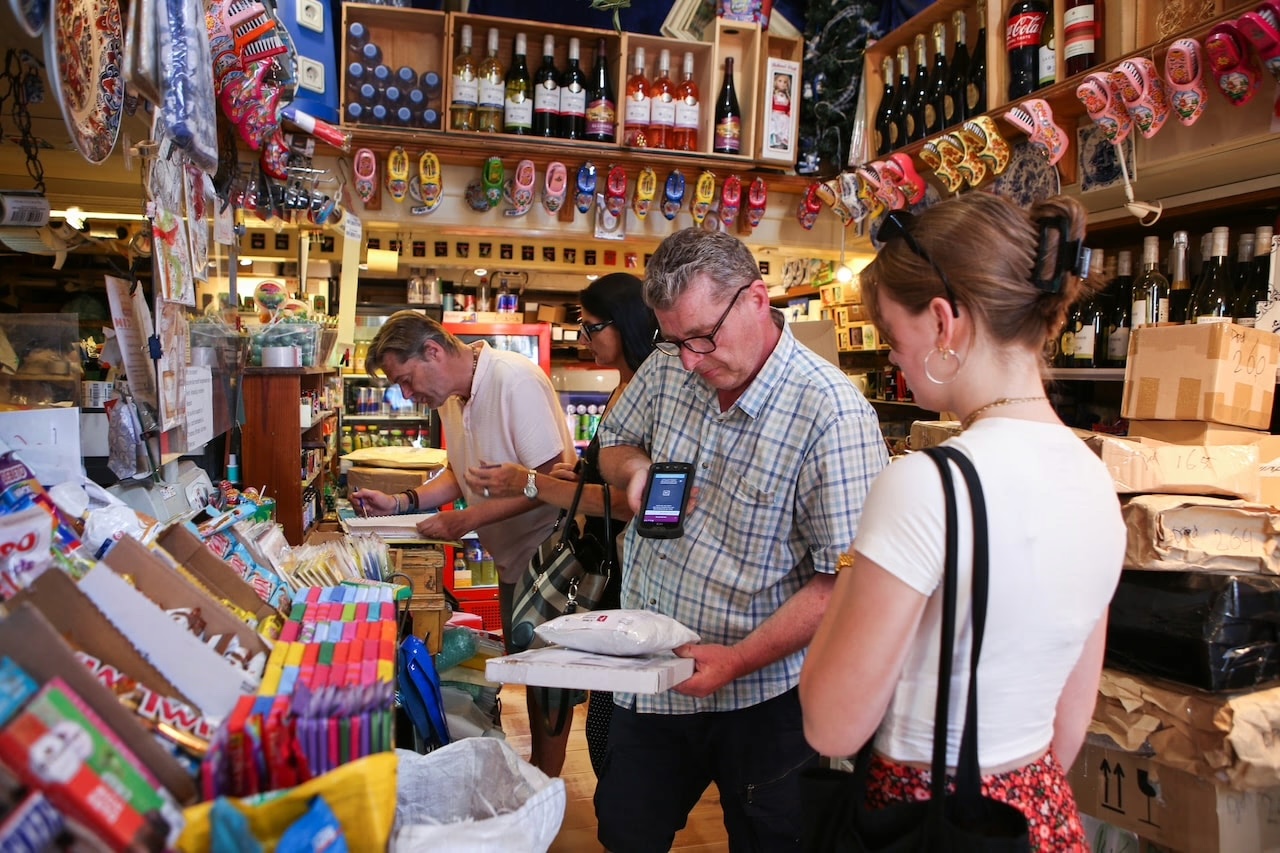
Warmoes Biënnale: wasserette x zoektocht

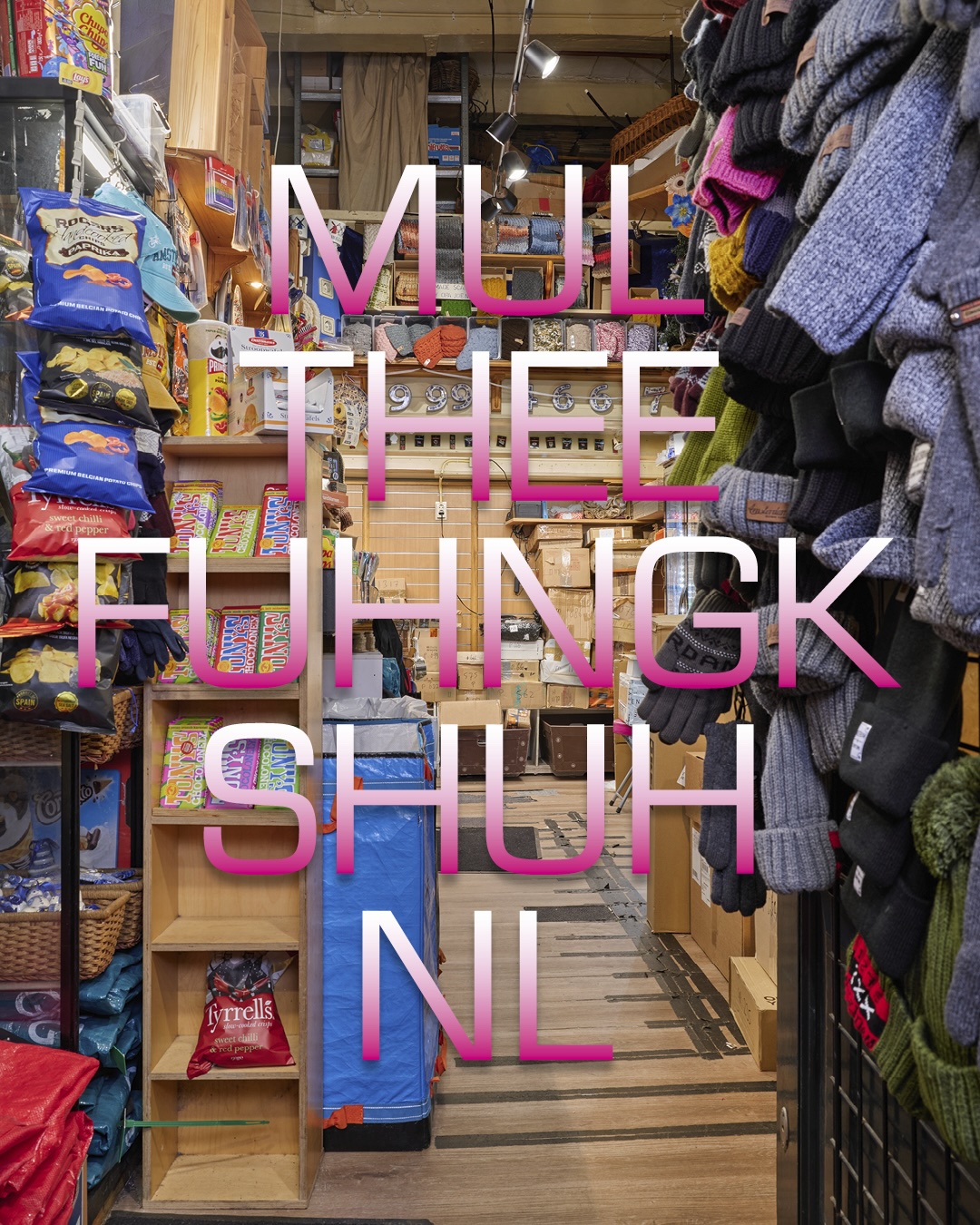
During the Warmoes Biënnale, mul-thee-fuhngk-shuh-nl will talk to waiting customers and passers-by about well-being. Stories, perspectives, and ideas on this topic will be collected during three pop-up editorial offices at the Effeness parcel point, Happy Inn Laundromat, and ORDER tattoo shop. At each location, they will address a different subtopic of well-being: pakketpunt x hechten, tattooshop x verlangen & wasserette x zoektocht. The findings will be published in three publications, which will be available in the participating pavilions of the Warmoes Biennale.

wasserette x zoektocht

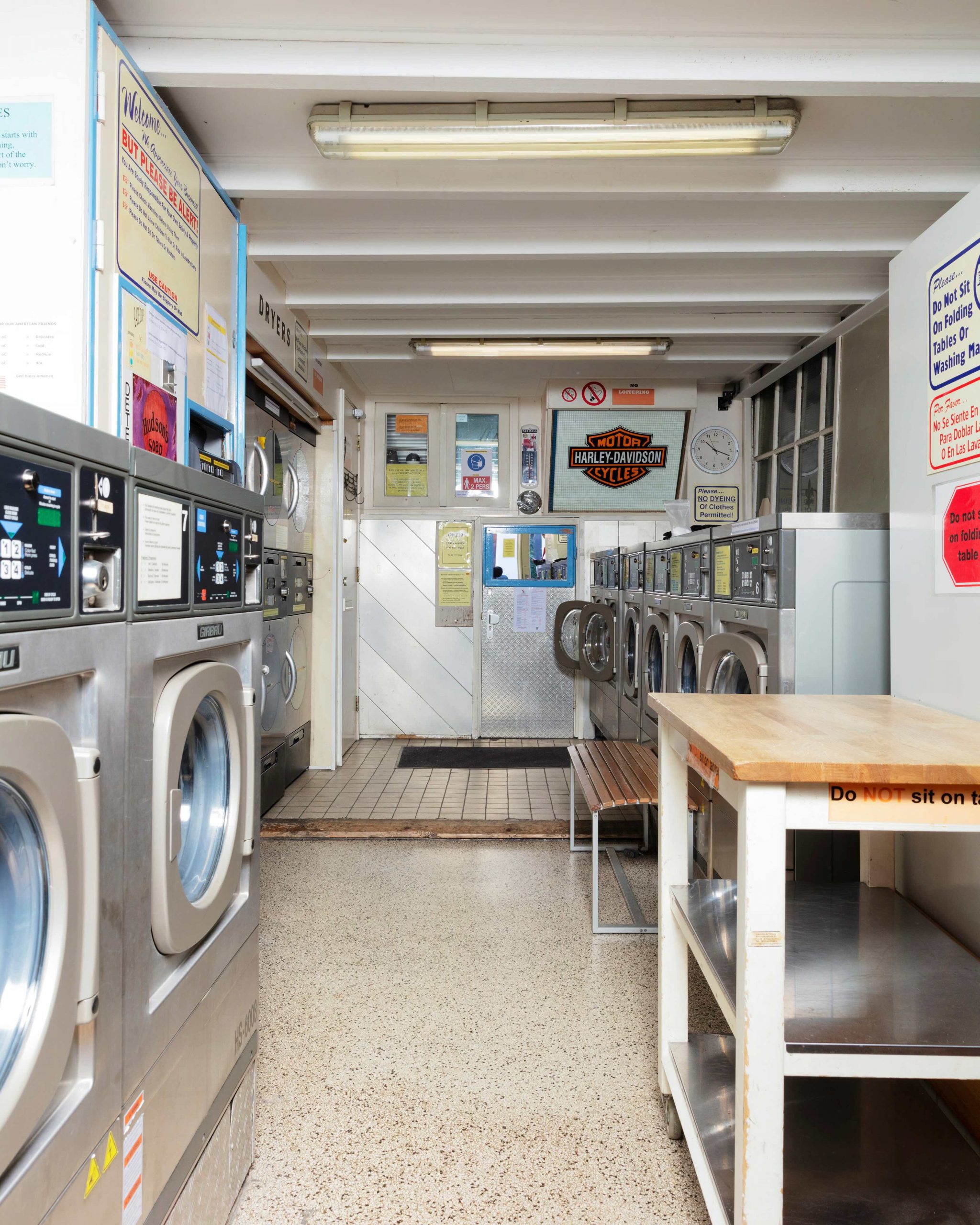
On April 4, mul-thee-fuhngk-shuh-nl will arrive at Laundromat Happy Inn, where the third editorial office will be located. Here, they will be discussing community. How do people relate to each other? What does it mean to belong to a community? And how do you find one? What is a community, anyway? Do you ever run errands for your neighbor, or do you secretly not know who she is? Can we read the future of community in the Warmoesstraat in the clean laundry? What has your dirty laundry been through? We collect utopias, reviews about neighbors, advertisements from entrepreneurs promoting their contribution to the community, and classified ads for social contacts.

Mul-thee-fuhngk-shuh-nl is a collective that creates dynamic installations with a crossover between workshops, public space installations, and happenings through interactions with others. Their projects share a common focus on engaging with the environment and fostering exchanges with a diverse audience, generating new imaginaries around the contexts the projects take place in.

Warmoes Biënnale: Wie we welzijn

During the Warmoes Biënnale, mul-thee-fuhngk-shuh-nl will talk to waiting customers and passers-by about well-being. Where does this issue stand in Amsterdam’s city center? What factors influence it? Stories, perspectives, and ideas on this topic will be collected during three pop-up editorial offices at the Effeness parcel point, Happy Inn Laundromat, and ORDER tattoo shop. At each location, they will address a different subtopic of well-being: parcel point x attachment, tattoo shop x desire, and laundromat x search. The findings will be published in three publications, which will be available in the participating pavilions of the Warmoes Biennale.

In the editorial office and in the publications, we will explore how we can look at our surroundings differently while waiting. The Warmoesstraat and its surroundings are a playground for imagining new ways of being and other uses for space beyond the functional. The editorial offices and publications are places where we look at things differently, question our surroundings, search for something that is not there, and create our own imaginings.

Mul-thee-fuhngk-shuh-nl is a collective that creates dynamic installations with a crossover between workshops, public space installations, and happenings through interactions with others. Their projects share a common focus on engaging with the environment and fostering exchanges with a diverse audience, generating new imaginaries around the contexts the projects take place in.

About the Warmoes Biënnale

For two months, artists, entrepreneurs, cultural institutions, and residents join forces to reveal the pulse of this neighbourhood. With art ranging from intimate to monumental—often in surprising locations—alongside events and genuine local hospitality, the festival offers a new perspective on this contested, yet deeply loved part of the city.

For more information, visit the website of the Warmoes Biënnale.

Gossib Gathering

Gossib Gathering is a research-oriented workshop that explores what shared care and community around parenting could look like today. This edition invites fathers, brothers; sons, uncles, friends, and allies—all people who were raised or are perceived as men—to reflect on their role in pregnancy, birth, care, and shared responsibility.

By using manual crafts—quilting and embroidery—as a meditative method, we create space for attentive conversations about parenting, emotional labor, and the social and cultural systems that shape our ideas about care and family. The workshop explores which support practices have been lost, which we can revive, and how we can develop new forms of solidarity and responsibility today.

The name “Gossib” refers to the Old English Godsibb, or “relative/spiritual neighbor.” In this workshop, we reclaim the word as a role of listening, caring, and supportive alliance. This edition, in collaboration with Hannah Kindler, focuses specifically on people who do not give birth themselves and invites reflection and practice around shared care and community.

The gathering is free or you can “pay what you can” we suggest an amount between €5 – €20.

Sign up for the workshop via this link.

Sanne Freijdag is a multidisciplinary artist and researcher working with textile, installation, film, and photography. Her practice opens a space where the “natural” is questioned as a human construct, examining traditions and rituals as recent formations shaped by productivity. Through embodied and material research, she explores care, interdependence, and collective memory.

Hannah Kindler is an artist whose practice explores feminist knowledge, care and embodied memory through textiles, sculpture, performance and media. Drawing on archival research and historical imagery, her work examines how power, gender and material histories are inscribed, transmitted and disrupted through bodies and objects. She lives and works in Freiburg, Germany.

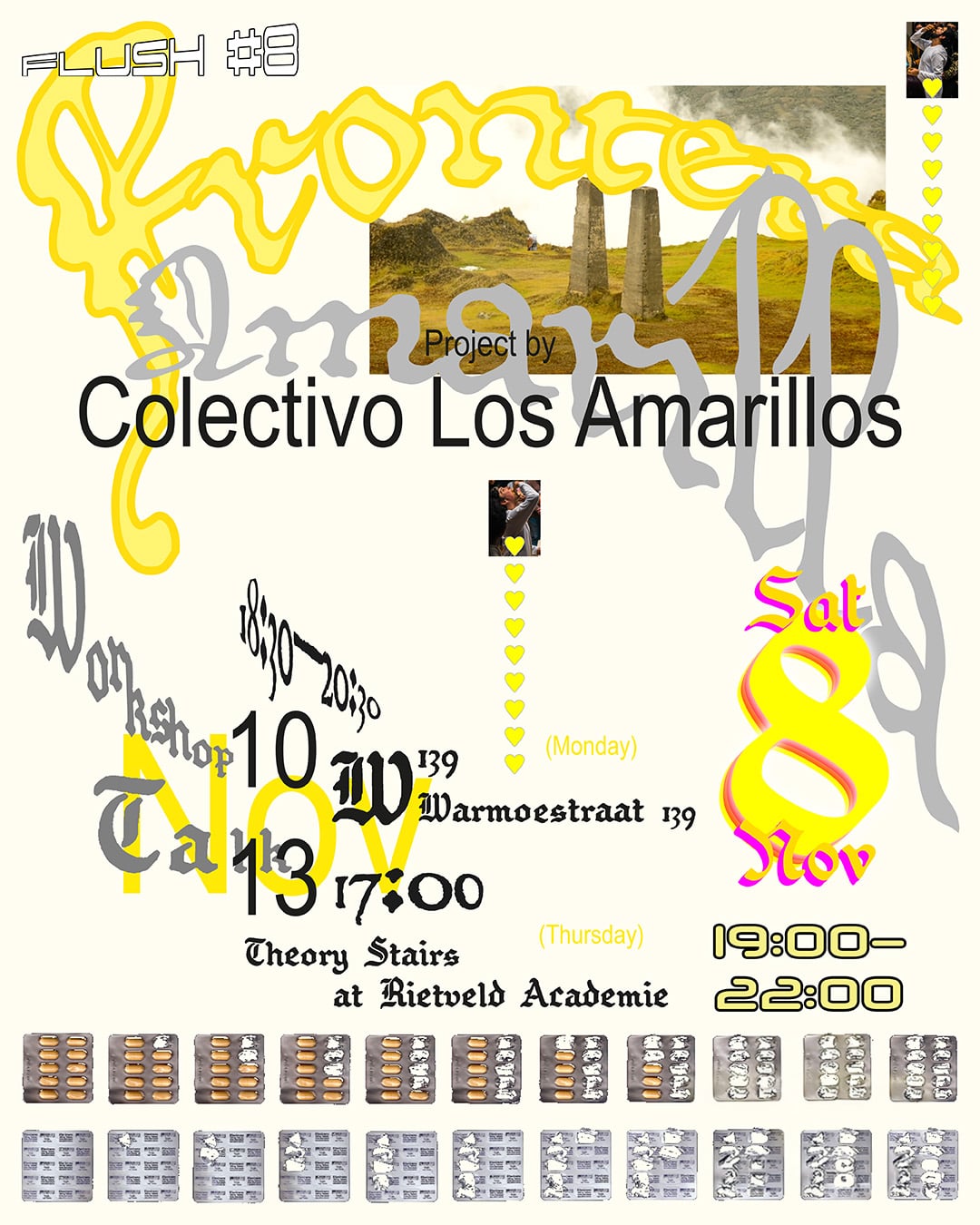
FLUSH #8: Frontera Amarilla

Faced with the tedium of patients who, time and again, return to receive a treatment that remains perpetual; with the side effects endured by some people living with HIV in Latin America due to low-cost medication, the privileges and restrictions in access, the logic of the pharmaceutical market, or the difficulties of migrating with HIV—Los Amarillos (a self-organized artistic collective from Colombia) propose and construct images that embody the demand, the desire, and the sacredness of bodies living with the virus.

The relationship with it becomes language and affective resistance—intimate yet collective, poetic proclamations that invite us to think of HIV not as an illness, but as a political symptom.

It’s about diagnosing utopias, to keep dreaming of a moving revolution. This room does not heal: it burns.

Colectivo Los Amarillos has carried out exhibitions, research, performances, and creative writing laboratories during the autumn of this year in several European cities as part of Frontera Amarilla, and now arrives in Amsterdam to open a space for denunciation, memory, and the celebration of dissident bodies.

Programme
Opening FLUSH #8: FRONTERA AMARILLA (at W139)
— Saturday 8 November, 19:00-22:00

Workshop with Colective Los Amarillos
— Monday 10 November, 18:30-20:30

Artist talk with Colective Los Amarillos (at Rietveld Academie)
— Thursday 13 November, 17:00-19:00

Production: Espacio Estamos Bien
Graphic design: Dun Lee
Text: Lou Vives

With the support of Monstrous Futurities, Romany Dear, and Kyle Tryhorn.

FLUSH is a flourishing collaboration between Espacio Estamos Bien and W139, located in the toilets of W139. FLUSH operates as a flexible form of organizing and creating, enabling various types of collaboration. FLUSH aims to foster inter-local relationships, viewing Amsterdam as a hub for facilitating diverse interactions and building connections that bridge distances. Joyful, friendly and decentralized connections extend beyond the Amsterdam art scene.

Para-siting: Tempodesert

Desert Without Sand: Sequential Practices is a space for contemplation and investigation into the desert as both a physical landscape, an abstract concept, and a site for speculation. Through a cluster of activities, including performative reading, public events, and mapping and diagramming workshops, Sequential Practices aims to navigate and discuss multiple performative practices approaching to the desert’s complexity.

Desert Without Sand came out of urgency to negotiate the multiplicity of the desert as a space of fugitivity, a land of resistance, as space of hermeticism, as nature, as un-nature, as site of erasure, as site of emergence, as stage for speculative futures, as memory keeper, as a map of silence and echoes, as witness, as site of grief, as myth, as home, as desert.

Friday 10 October — First Sequence
Friday 17 October — Second Sequence
Saturday 25 October — Third Sequence
Friday 31 October — Fourth Sequence

Tempodesert is a performance-based collaboration between Fay Aldhukair and Mohamed Abdelkarim, with occasional contributions from others. It emerged after experiencing the world “after 8/8,” a term coined when Fay and Abdelkarim watched The Draw of the Desert 8/8 Seminar by Iranian philosopher Reza Negarestani on March 15, 2024.

They operate as a performative lab, poetically exploring the holistic and layered temporalities of the desert, geological, ephemeral, eternal, and mythological. Through various mediums such as performances, plays, texts, songs, films, publications, workshops, and walks, Tempodesert seeks to investigate, reclaim, and liberate the desert from colonial narratives and imposed perceptions.

Desert Without Sand: Sequential Practices was made possible by Ettijahat and CBK Rotterdam.

Amsterdam Conference of Autonomous Book-Makers

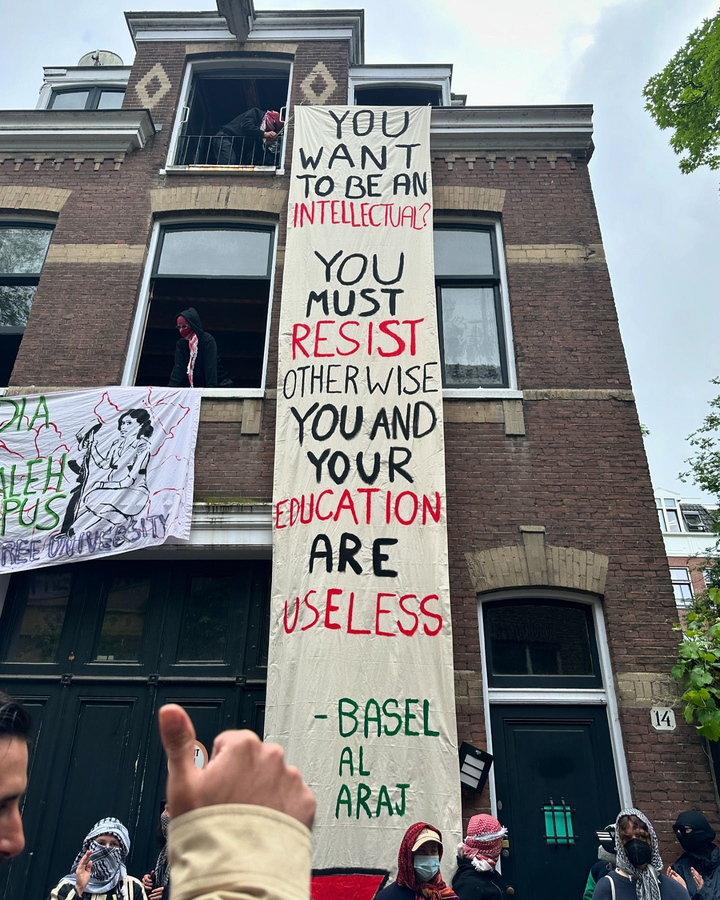
“To create is to resist”, the more so when we do it together. On the last day of Spooktember, come in to make your own buttons or screenprint your clothes, while we’re joined by other autonomous and anarchist book and zine crafters to provide a mini book and zine fair!

Spookstad is a publishing collective that emerged from the squatting movement in Amsterdam. They make books in close collaboration with various activist collectives.

Between Palestine and Us: publishing in the service of solidarity

The student encampments of 2024 marked a first global wave of mass mobilizations in support of Palestine and against Western complicity. On the basis of the Spookstad-published book about the student uprising in Amsterdam, we explore how art, writing and documentaries contribute to the Palestine solidarity movement, and how we can take it further.

Programme Saturday 20 September

14:30 — Mapping solidarity: interactive session hosted by Saja Amro. What is the role of art, cultural work, academia, and activism in the West, particularly in the Netherlands, in times of genocide? And how to strengthen our networks to avoid fragmentation and consolidate our strategies towards effective aims? 

We will create a map together to serve as an active tool for documentation and strategy building. This session is a continuation of the Mapping Solidarity Project, in collaboration with platform BK. Please register by sending an email to hello@spookstad.boo. 

16:00 — Film screening “Class outside”: a collective video diary capturing everyday moments of resistance, solidarity, and conflict, following the student encampments in Amsterdam during May 2024 and the various subsequent actions. By Aylin Kuryel, Fırat Yücel & Deniz Buga.

17:00 — Performance of “Dear, Comrade”, by Lila Swindles and Olga Tsyganova. A play about the student occupations, resistance, collectivity, and the attempt to not lose hope. 

Program will also be part of Amsterdam Bangs Festival.

Spookstad is a publishing collective that emerged from the squatting movement in Amsterdam. They make books in close collaboration with various activist collectives.

Take Back Mokum: squatting, printing, and the right to the city

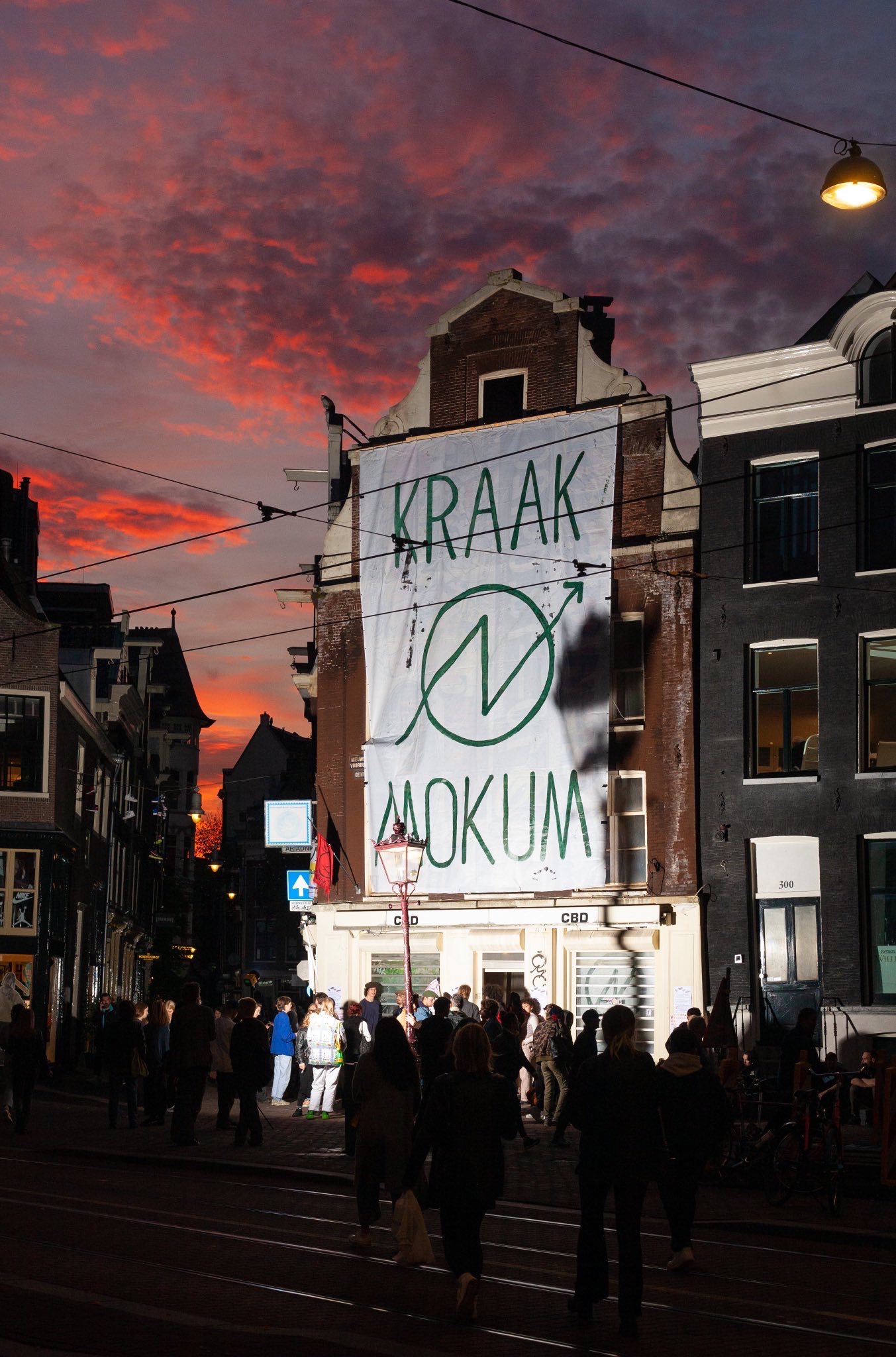
Against the forces of capital and the housing crisis, squatting is one of our best remaining tactics of resistance. It is also an inherently creative act, transforming buildings, public space, and potentially the whole city. Spooktember opens with the launch of our new zine about the Klokkenhof squat and invites you to explore together how to reclaim the right to the city. 

Programme Saturday 13 September

18:00 — Expo opening! Launch of zine Permanence Through Print (made by Layla Gijsen & Boris, published by Spookstad), music by Big Toilet Radio, drinks, art, zines, books.

Programme Sunday 14 September

13:00 — Linocut workshop by Layla Gijsen. Free, but register by sending an email to: laylagijsen@gmail.com

16:00 — Film screening new video work by Yannesh Meijman, with a Q&A after.

Spookstad is a publishing collective that emerged from the squatting movement in Amsterdam. They make books in close collaboration with various activist collectives.

Monster Mash

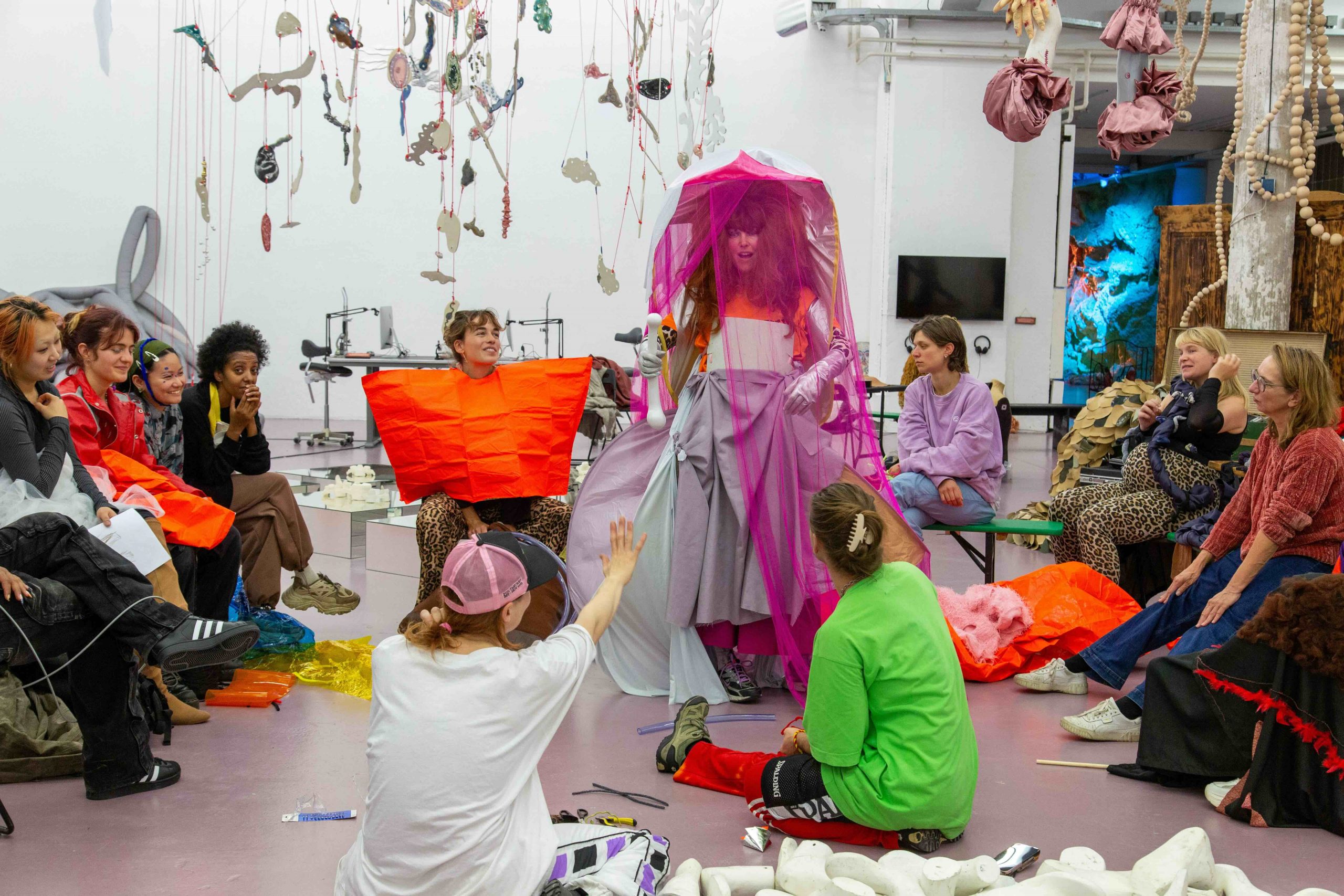
Monster Mash is a three-day workshop series where Mette Sterre, Lady Bag, and Ainhoa Hernández Escudero join forces to create a tour de force full of fun. Together, they invite you to explore your inner monster and give place and face to the non-human cells that make up more than 50% of every human body.

In the workshop, Lady Bag guides participants in building their own movement vocabulary through physical play and sculpting the body with accessories and materials. We will begin by warming up through dancing with bags—our first prosthetic companions—before swapping them for other objects, costume pieces, and materials.

Ainhoa Hernández Escudero shares DIY makeup and costume techniques developed through drag, alongside physical and character-building exercises from their theatre and dance training. Through playfulness you will learn more about costume making, face paint, and how to construct your demonology by deep diving into the body language of your persona. 

Through experimentation, we’ll explore how adding elements to the body can enhance, limit, or radically shift movement. As we discover our “enhanced” bodies, we’ll bring these new possibilities into space through group play. The session climaxes in a Monster Catwalk, where we present their transformed physicality—showing off their altered movements, and creaturely styles.

This series prepares for a collective performance at the Monster Ball at W139, which will take place on Thursday 30 October.

Who are we looking for:

  • You are able to join all three workshop sessions (Monday 6 Oct, 13 Oct, 20 Oct)
  • You are available to participate in the collective performance
  • A commitment to explore performing in public space
  • Eagerness to learn and play together
  • You embrace the sometimes unpleasantness of the unknown 
  • You don’t mind awkwardness 
  • Openness to explore the movement potential of your body
  • Willingness to work on your monstrosity homework in between workshops

Each session begins with a shared warm meal.

There are only 12 spots available. Please fill in the complete application form so we can get to know you. You can apply for the workshop program via this link.

Workshop day 1 — Monday 6 Oct, 18:00-22:00
Workshop day 2 — Monday 13 Oct, 18:00-22:00
Workshop day 3 — Monday 20 Oct, 18:00-22:00

Admission fee: €30 (incl. light catering)
Students: €20 (incl. light catering)

Mette Sterre is a visual artist who investigates the limits and transformative potential of the body. Her work resists categorization, fusing performance, sculpture, body masks, and digital technology into immersive, otherworldly environments that explore the threshold between the organic and the artificial. By entering her work we are cast into the materialisation of her mind processes: a sensorial and embodied experience.

Peter Cripps Clark, AKA Lady Bag, grew up in Melbourne, Australia, where he began his formal dance training, completing it at ArtEZ University of the Arts in 2015. After dancing for Konzert Theater Bern and Marion Zurbach’s Unplush company, Peter joined the House of Hopelezz in 2019, an Amsterdam-based drag family. Peter’s drag persona, Lady Bag, performs regularly around the city—exploring object-oriented performance and developing Bag-Aerobics, a drag movement workshop focused on dancing with bags. These workshops have been presented at institutions of arts education including the Rietveld Academie, SNDO, and ArtEZ.

Ainhoa Hernández Escudero is an interdisciplinary maker, performer, and cultural worker from Carabanchel, Madrid, based in Amsterdam. They are part of the drag House of Løstbois. In her work, she explores the strange and the monstrous at the intersection of magic, pop, the post-internet aesthetic, technology, and mainstream culture. Ainhoa is a research coach at the Bachelor Dance Artist at ARTEZ.

Photos by Kyle Treehorn
Processes, Practices, and Production: Infrastructures for Collective Work

The workshop-filled day shows how the Doe-Het-Zelf Werkplaats collectively designed and built a party office for the PPP by making armor to protect yourself, floating ink printing, book-binding, and writing mythical stories.

Our impulse in taking on this project was to develop collective structures and working methods: How do we co-create a design? Allocate hours and responsibilities? Make decisions? We embraced infrastructures that let us improvise, hold complexity, and share a foundation (and Excel sheets), aiming to make this knowledge portable. Now that we’ve finished our build-up, we want to reflect as a collective on how our intentions arrived in practice. The office is also a working site: for growing potatoes, making ink, posters, publications, and potato paper—alongside items from the PPP fabriek, in the rear of W139.

Doe-Het-Zelf Werkplaats is a free-to-use, collectively-run (squatted) workshop space and community garden in Rotterdam operated by volunteers. Visitors come to fix their bikes with tools and spare parts that have been donated while neighbors can freely harvest herbs from the garden. Centered around learning together, reciprocal generosity, and anti-judgement, the space creates a welcoming environment where folks can safely relate to each other on the border of what they know and what they are trying to figure out. DHZ consists of Deniz Gülyurt, M.B. McGregor, Christian Lesmes, Florian Henschel, Sapozhnikov Mikhail, Linda Zeb Hang, Tomi Hilsee and Saina Salarian.

Programme

DHZ Introduction
12:00 – 13:00

Rhythmic Publications: Floating Ink Printing And Binding
Linda Zeb Hang
13:00 – 15:00

Learn the flow of Suminagashi, or the art of Japanese water marbling, which in this workshop is a large-scale collaborative printmaking process. Participants will be guided through the steps of using natural brushes to create floating ink designs on water with accordion wind fans to manipulate the surface. They will then transfer the design onto paper by hand pulling each unique print. Participants will be using 6 colors of inks to create the designs in a water vat installed at W139, and make up to 4 small and 4 medium sized prints. Prints will be bound into a booklet during the following workshop, folded into signatures and bound by hand using needle and thread.

Linda Zeb Hang is a queer Hmong-American, Rotterdam-based artist best known for their conceptual artist’s books, hypnagogic book design, sculptural installations, fine art printmaking and experimental video art. Their content of scanning voices cross-sections the invisible density, flavor profiles, and omniscient presence of the woven, yet frayed environment. They consider innovative organizing to be objective oxygen, interacting with media to animate the duality and ‘non-duality’ of space. They shape sound and material cultures through technical experimentation, working spontaneously, collecting and generating information to arrive at a knotty mixed-media synthesis. Flexibility, instinct and intuition are their chosen guides. Their tools are digital, machine age and ‘primitive.’ 

Mythical Storytelling: Potato Power Parables
Deni
14:00 – 16:00

This month, we dug beneath the surface —literally and metaphorically— with the potato as our guide. Often used to spin colonial myths, the potato reveals the tangled truths of global history: how the resources of the Global South have long fed the North, even as modern narratives claim the opposite. In this workshop, we’ll explore how dominant stories —crafted by colonial and capitalist powers— have shaped our understanding of history, identity, and belonging. We’ll ask: Whose stories get told, and whose are silenced? Together, we’ll read a short excerpt to break the spell of so-called “realistic” capitalist storytelling, then turn to the empowering art of mythical storytelling. Through writing laments, prayers, dreams, and wishes, we’ll reclaim our voices and imagine new worlds. Whether you want to mourn what’s lost, dream of what could be, or simply tell the world as you see it, this is a space to write the stories only you can tell. Come ready to question, imagine, and write your own myths—rooted in truth, resistance, and possibility.

Deni is a Rotterdam-based collective member who is interested in topics of individuality, nature of experience and perception, and creating multi-sensory media for self-expression. She is studying neuroscience and working in a wet lab everyday, where she gets to test and explore her own perceptual space and relatedness to the living organisms she is “manipulating.” She brings together her different selves to explore the boundaries of her material existence and expresses these ideas mostly through music, collages, and drawings. 

Press Play and Protect: Making Wearable Resistance (Armor) & A Sonic Ceremony of Collective Resilience
MB McGregor and Saina (DHZ)
15:00 – 18:00

This workshop brings together making and listening as ways to think about protection—both personal and collective. We’ll start with a hands-on session where you can create wearable pieces using discarded bike parts, soft fabrics, and found objects. Think of it as DIY armor: something that holds strength, softness, protest, or play. Materials like inner tubes, chains, grommets, and fabric will be provided, with space to experiment and shape things in your own way. You can follow examples, ask for support, or just dive in freely. 

MB (MaryBrown) McGregor is a Rotterdam-based, California born landscape architect, DJ and queer interdisciplinary artist whose practices live at the intersection of spatial design, social intervention, and collective resistance. They work to challenge status quos — whether through public space design, interactive installations, or nightlife politics. 

Saina is a Netherlands-based Iranian researcher and organizer. Their work floats somewhere between music and politics. Centering radical care and joyful activism in their work, Saina’s interests range from sound to solidarity; they aim to weave a sound tapestry dedicated to the interconnected struggles for liberation.

Sonic Ceremony
18:00 – 20:00

Later, we’ll shift into a shared listening session—a kind of sonic ceremony—featuring a mix of sounds and songs of resistance from different parts of the world. This will be an intentional space to sit or move with grief, rage, and uncertainty—transforming these emotions through sound and shared presence. In a world where relentless atrocities stream constantly into our hands, this gathering offers a moment to pause, listen deeply, and process together. Through movement, sound, or writing, we channel stagnant political rage into imagination, action, solace, and resistance. No experience is needed—just openness.

Come to build, to listen, to be with others in a space where making becomes a form of resistance, and sound becomes a way of holding space. Whether you’re crafting armor or simply showing up, this workshop is about presence, protection, and protest in many forms.