Codicil Screenings: Christopher Tym

Codicil Screenings is a screening program that runs in the front space of the W139 until September 2018. Every Thursday evening an artist is invited to present their work amongst other moving images of their choice. A codicil is an addition or supplement that explains, modifies or revokes a will.

Codicil Screenings is een screeningprogramma dat t/m september 2018 in de voorruimte van de W139 werd gepresenteerd. Elke donderdagavond wordt een kunstenaar uitgenodigd om hun werk te presenteren in relatie tot andere bewegende beelden van hun eigen keuze. Een codicil is een toevoeging of aanvulling die een testament uitlegt, wijzigt of ongeldig verklaard.

Op donderdag 19 juli begint het programma met Christopher Tym, wiens werk vaak visuele vocabulaires verkent die gebruikt worden in massamedia. In de loop van het programma zal Axel Linderholm in de voorruimte van de W139 zijn werk ontwikkelen.

The Frame Cannot Hold the Ghosts

A screening and reading programme with Komtouch Napattaloong, Kaisa Saarinen, and Bart Seng Wen Long, which extends out from the trio’s collective installation, bringing focus to their distinct yet sympathetic forms of narration and storytelling. In collaboration with the Prince Claus Fund.

Lingering within the hallowed space of the make-shift rubber tapper shelter in the main exhibition gallery, between the CRT monitor and the modern flatscreen and the stacks of anarchronistic agitprop, are persistent ghosts biding their time to re-manifest: as kinky anecdotes of a middle-aged Singaporean rubberist; a veteran camcorder on its last pixels; eccentric mythologies that have built and continue to sustain a nation’s spirit; the dreams sustained by freebleeding trees night after night.

They gather in the screening and reading programme, The Frame Cannot Hold the Ghosts, which expands on the various themes entangled within the installation, featuring three short films, an interview with a gimp, and excerpts from a hybrid nonfiction-in-progress.

This event will be held in English.

Ticket: €7,50
Student and solidarity ticket: €5

Buy your tickets via Eventbrite.

Film programme

Phi Pattana / In Sum (2026), 17 min
Corroded pixels struggle to form an image as they move through Cold War promises of development in rural Thailand, haunted by archival voices.

Emergencies (2025), 15 min
A Singaporean man mixes up two memories: one of a colonial-era propaganda film about communist insurgencies in rubber plantations, and another of his Malaysian ex-playmate.

No Exorcism Film (2024), 20 min
As one robotic voice recounts nightmarish returns to Thailand, another seeks to console.

Field Interview #2 (2025), 5 min
On the elevated walkway of Singapore’s Plantation District, a social housing estate built on top of a colonial-era rubber plantation, M. Shah hones his kickboxing drills clad in his preferred sportswear—a head-to-toe rubber suit.

All of It Transforms into Something Nobody Knows (Ongoing)
Emerging from and building on an ongoing research-based art project around rubber, All of It Transformed into Something Nobody Knows is a hybrid non-fiction book that explores the material as a commodity fetish & fetish commodity.

Komtouch Napattaloong (he/him) is a visual artist and filmmaker based in Thailand. Working across experimental, documentary, and ‘post-documentary’ cinematic forms, his practice involves identity deconstructions, migration narratives, and historical translations to examine the nature of memory, displacement, and image agency.

Kaisa Saarinen (she/her) is a Finnish researcher, poet, and novelist based in London. She writes about false dichotomies, country girls lost in the dazzle of big cities and other underdogs, strange desires and painful transformations, with particular attention to the absurd pleasures and frequent horrors of living through an ongoing apocalypse. Together with Bart Seng Wen Long, she is leading the Rubber Dreams of its Lifetime project.

Bart Seng Wen Long (he/him) is a Singaporean artist, filmmaker and curator based in London. His practice spans moving images, photography, expanded cinema and performance, revolving around confrontations between reality and fantasy, and how in the heat of such encounters, they reveal the interconnectedness of things within the political economy of desire.

Image: still from Phi Pattana / In Sum (2026) by Komtouch Napattaloong.

The residency of Komtouch Napattaloong is part of the Exchanges programme by the Prince Claus Fund, with the support of the Amsterdam City Council.

Codicil Screenings: Alex Reynolds

Codicil Screenings is a screening program that runs in the front space of the W139 until September. 2018 Every Thursday evening an artist is invited to present their work amongst other moving images of their choice. A codicil is an addition or supplement that explains, modifies or revokes a will.

On Thursday the 16th of August Alex Reynolds will present her new film, This Door, This Window. Operating as a double portrait of choreographer Alma Söderberg and drummer Nilo Gallego, the film reflects on the theme of cohabitation through sound, exploring the idea of living together as a matter of negotiating rhythms, earworms and boundaries. In addition to this, Alex will present a selection of rhyming films and recordings she loves.

after afterlives: film screening and talk programme

What does the ground unleash when it is denied keeping what it holds? How does soil get implicated in the carrying of catastrophe? And how does continuous excavation for artefacts reveal an obsession to erase history in order to create a new one? Against this erasure, how have material knowledges of burning, plastering, and burying offered different approaches to the ground—one where land and flesh are bound together in a rhythm of constant transformation? These are some of the questions we’ll be engaging with during this program, which will expand on the works of Areej Ashhab and Ola Hassanain, in the flour, water, soil exhibition, and bring in the work of Dina Mimi, to open up a conversation about the artefact as witness, the erasure of history through excavation, the objects and topologies of repair, and the relationship of people to their material environments. 

Areej will be sharing excerpts from her film Lime Through the Elements, and connecting them to her new installation, The Ground Keeps What it Holds, commissioned for this exhibition.  The work engages ancient burial practices in Palestine and the aftermath of their settler-colonial excavation. Through field research, experimentation, and collective labor, the film revisits the lost practice of lime making in Palestine and its elemental journey back to limestone as a reflection on return—what survives erasure and elimination.

We will also be screening Dina Mimi’s short film The Eyes That Never See, which narrates the story of Ram(z)i, a lonely working class man who died twice. Ram(z)i was renamed as soon as his first body died, to die again in Jerusalem, under the dusty ground while digging for artefacts from a 6,000 year-old ancient city. Just like in Areej’s work, Dina’s film exposes the obsessions of a settler state that continuously excavates, digging deep into the ground, to find artefacts in order to create new histories.  

Ola will present her spatial installation for the exhibition, Water Collection Points, and contextualise it within her ongoing project Tell The Water What The Clay Kept Secret. The work uses water collection points across the exhibition space to make visible the efforts to repair the environment that emerge at the onset of catastrophes. Framed as a site for the ‘ecology of repair’, Ola examines this collective effort to deal with crisis by highlighting roles within communities—especially those living near water—where watching and listening emerge as spatial practices shaped by environmental and political rupture. 

The films and talks will be followed by a conversation between Ola, Dina, and Areej, moderated by Margarita Osipian—interweaving their individual works and the stories that unfold through them.

Ticket: €7,50
Student and solidarity ticket: €5

Buy your tickets via Eventbrite.

Areej Ashhab is an artist and researcher whose work addresses material heritage loss, more-than-human ecologies, and land politics. Areej’s practice spans material experimentation, writing, and film, and often unfolds collectively through walks, workshops, and shared meals. She is the co-founder of Al-Block, documenting lost narratives of the Palestinian landscape through collective walking, and Al-Wah’at, a translocal collective countering anthropocentric and colonial narratives around arid lands and futures. In her recent project A Hand of Fire and Stone, she traced abandoned lime pits in Palestine, built a lime kiln prototype in Bethlehem, and activated this lost architecture through fire, songs, and meals; following the elemental cycle of lime from stone, to paste, and back to stone.

Ola Hassanain is an artist whose work moves through architecture, film, and spatial strategies to reflect on how power becomes visible—and felt—through built environments. Her practice engages with places shaped by climate instability, postcolonial legacies, and displacement, thinking through the politics of inhabiting and how ecological and social systems shape one another across time. As she notes, “observation summons a form of power”.

Dina Mimi is an artist working in experimental film and moving image, exploring how, and when, bodies become sites of resistance. Often using found footage to explore themes including smuggling and tactics of movement, her work adopts non-linear forms of narration. She approaches editing as an open and exploratory process, experimenting with the opacity of footage—images that are in the act of vanishing.

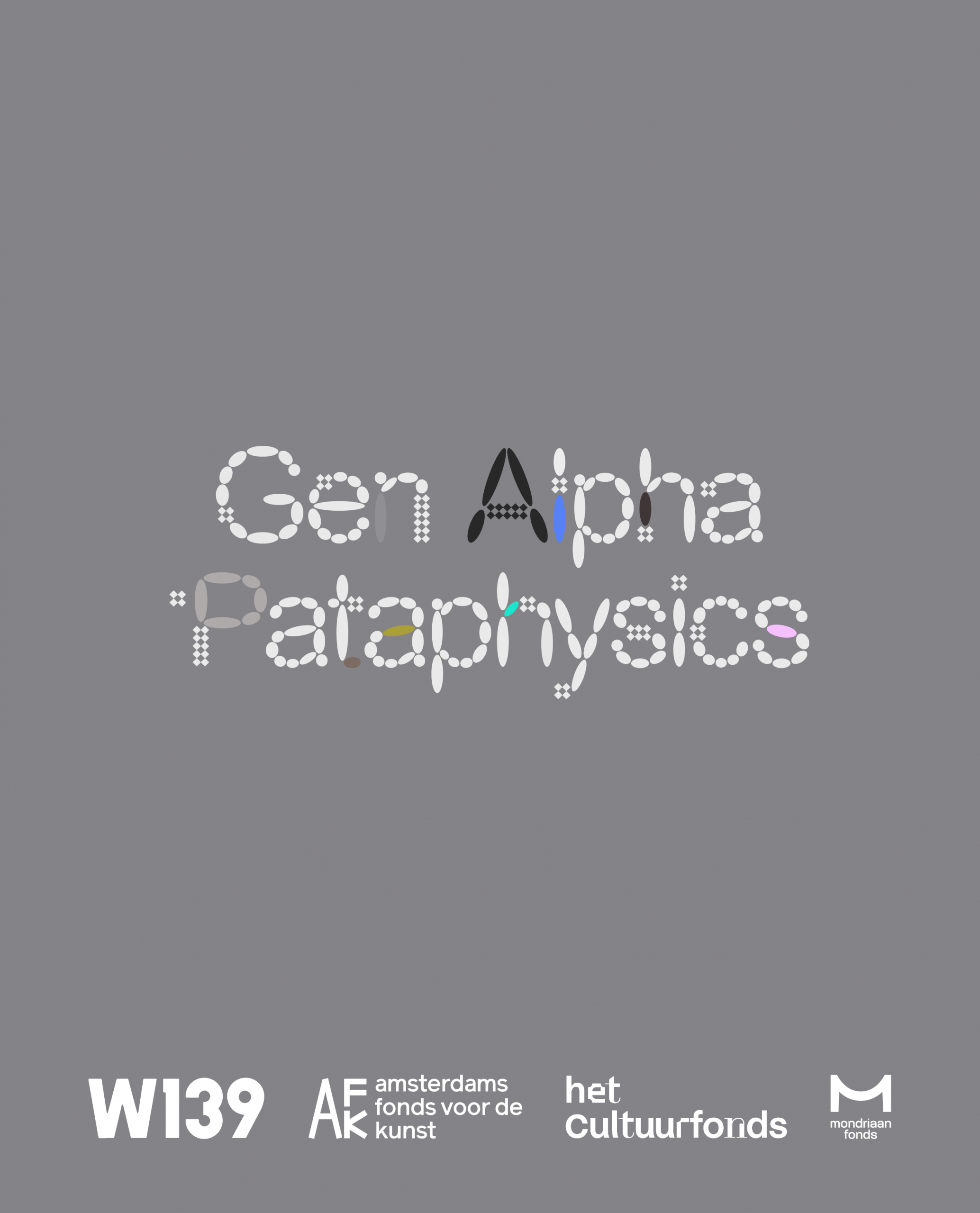
Gen Alpha ‘Pataphysics

Gen Alpha ’Pataphysics is a film documenting a think tank style workshop with children born after 2010, centred on the theme of money. Developed in collaboration with art educator Studio Dicky, the workshop invited participants to collectively imagine and govern a fictional city, determining how resources should be allocated and which values might underpin economic life.

The film combines scripted text, open discussion and a collaborative role playing game. Ideas surface through logical fallacies, non sequiturs and cognitive leaps, as participants test the coherence of an invented system in real time. What begins as a structured moral and civic debate gradually becomes unstable: as fake currency, theft and improvised rules are introduced, the system is enacted to the point of breakdown. 

The film forms part of the broader Gen Alpha ’Pataphysics project: a series of workshops using drawing, writing, acting and speculative design to examine how children understand and reimagine the systems that organise their lives. Alongside the workshop on money, participants also developed the Union of Supernatural Conservation, an imagined organisation advocating for the rights and housing of supernatural beings such as fairies and elves, which is planned to be legally established in Amsterdam concurrent with the film’s screening. While not the focus of the work on show, this parallel strand clarifies the project’s wider methodology: treating children’s speculative reasoning not as metaphor but as a workable model for thinking through governance, care and collective responsibility.

Rather than positioning children as future citizens in preparation, Gen Alpha ’Pataphysics treats them as contributors to the present; the film maintains space for uncertainty, contradiction and novelty, allowing ideas to unfold without resolution or didactic framing. In doing so, it offers a view of economic imagination shaped by lived experience, intuition and play, exposing both the fragility and the productive limits of the systems we continue to inherit and reproduce.

Aaron McLaughlin is an artist and curator based in Amsterdam. Working with those marginalised by institutional processes and appropriating common forms, his practice joins objects, procedures and communities to reframe accessibility and question how art contexts control flows of people, ideas and aesthetics.

Between Palestine and Us: publishing in the service of solidarity

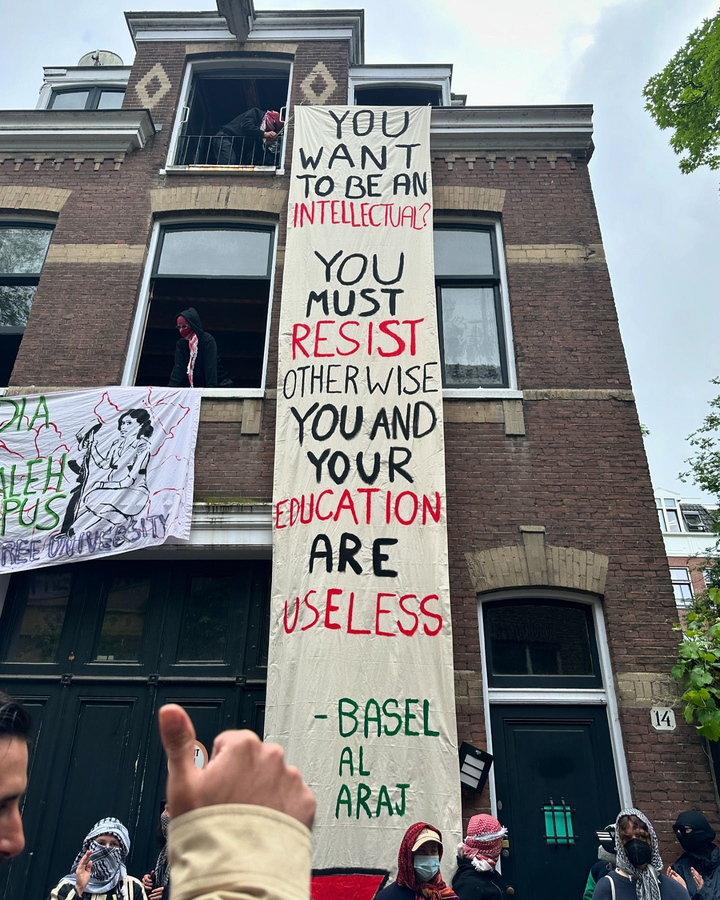
The student encampments of 2024 marked a first global wave of mass mobilizations in support of Palestine and against Western complicity. On the basis of the Spookstad-published book about the student uprising in Amsterdam, we explore how art, writing and documentaries contribute to the Palestine solidarity movement, and how we can take it further.

Programme Saturday 20 September

14:30 — Mapping solidarity: interactive session hosted by Saja Amro. What is the role of art, cultural work, academia, and activism in the West, particularly in the Netherlands, in times of genocide? And how to strengthen our networks to avoid fragmentation and consolidate our strategies towards effective aims? 

We will create a map together to serve as an active tool for documentation and strategy building. This session is a continuation of the Mapping Solidarity Project, in collaboration with platform BK. Please register by sending an email to hello@spookstad.boo. 

16:00 — Film screening “Class outside”: a collective video diary capturing everyday moments of resistance, solidarity, and conflict, following the student encampments in Amsterdam during May 2024 and the various subsequent actions. By Aylin Kuryel, Fırat Yücel & Deniz Buga.

17:00 — Performance of “Dear, Comrade”, by Lila Swindles and Olga Tsyganova. A play about the student occupations, resistance, collectivity, and the attempt to not lose hope. 

Program will also be part of Amsterdam Bangs Festival.

Spookstad is a publishing collective that emerged from the squatting movement in Amsterdam. They make books in close collaboration with various activist collectives.

The Myth of a Life Sentence, أسطورة المؤبدات

As part of Saja Amro and Wassila Abboud’s on-going research program Remove the Dot, they’ll be screening excerpts from a recent interview with newly released political prisoner Wa’el Jaghoub with a short discussion following the screening. 

Wael Naim Ahmed Al-Jaghoub was born in 1967 in Beita, a village south of Nablus. Al-Jaghoub was first arrested in 1992 and spent six years in prison before being released in 1998. His release period was cut short by a second arrest in 2001 which held a significantly harsher sentence of life imprisonment. While this period in prison was also met with harsher daily conditions, including long periods of solitary confinement, he continued to write and wrote several books capturing what he saw and understood from within the prison walls. During this time he also played a significant role in organizing within the prisons, serving as a leading figure in the Popular Front for the Liberation of Palestine (PFLP). 

In this conversation, Wael recounts his time in prison, and his reflections on the occupation as a fantasy of dust هذا الوحش وهم من غبار. He reflects on the struggles of Palestinian prisoners whose sacrifices would not be in vain.

The event is free but space is limited, so please register via Eventbrite.

Ancient West African Principles

A wasi in JawJaw (2008) is a short documentary film recorded during a trip to the interior of Suriname. Rainbow Soulclub members Ebby Addo and Roy Telgt (a.k.a. Totty) are given a ritual washing and treatment against addiction by Mr. Amou, a local Obiya man (medicine man).

After screening the film, spiritual holistic therapist Orsine Walden will dissect the ritual conducted in A wasi in JawJaw, through a lecture on ancient West African principles.    

Orsine Walden is a spiritual healer, poet and holistic therapist applying ancient African principles. Walden descends from the Marron Saamaka freedom fighters, who built their own communities and have resisted slavery not only in Suriname, but also in other regions on the South American continent.

At the age of 17, Walden was initiated by her grandmother Yaadoka into the Winti world of faith. She started her own spiritual holistic therapy practice since age 23.

Buy your ticket on the Eventbrite-page of the event.

Cosmic Entanglements

Since March 2024, Buro Stedelijk has hosted the monthly speculative fiction reading group Goddess Change, initiated by artists Anna Hoetjes and Müge Yılmaz, who are also the initiators of Taking Root Among the Stars. As an extension of the exhibition at W139, Buro Stedelijk will host a film screening evening that brings together films that expand on the quantum realm—using it as a framework to propose different social realities and relationships to time, alternative futures, and communal relations to nature.

The program opens with Larissa Sansour’s The Nation Estate, a 9-minute sci-fi short film and a photo series offering a clinically dystopian, yet humorous approach to the deadlock in the Middle East. With its glossy mixture of computer generated imagery, live actors and an arabesque electronica soundtrack, the Nation Estate film explores a vertical solution to Palestinian statehood. Palestinians have their state in the form of a single skyscraper: the Nation Estate. One colossal high-rise houses the entire Palestinian population – now finally living the high life.

Tres Lunas más Abajo [Three Moons Below] by Patricia Dominguez will have its Netherlands premier as part of this film program. Tres Lunas más Abajo is a spi-fi (spiritual fiction) cinematic exploration that crosses the spiritual and quantum realms. In this fictional universe, CERN’s physics experiments and the astronomical observatories in the Atacama Desert converge with ancient petroglyphs, creating portals that transport the protagonist and her robotic bird companion. Together, they embark on a journey through otherworldly realities, consulting with mystical beings and acquiring celestial antennas and particle detectors.

Domínguez’s personal, futuristic, and unearthly imagery is informed by her extensive research, spanning experimental sites to studies in ethnobotany and South American spiritual practices in plant healing. At the heart of their quest lies a prayer to identify and care for one’s entangled particle. The protagonist contemplates the nature of her entanglement, wondering if it could be with a machine, a wounded bird, or even a star in the distant Andromeda galaxy. The film explores the desire to feel, experience, and learn through these entanglements, offering a world vision in which everything is intertwined in a cosmic knot. By merging ancestral knowledge and contemporary science, the film expands our understanding of the universe beyond the tangible and visible. It advocates for a need to form connections between all living things, machines, and other entities, to develop more sustainable and supportive ways of existing. 

The second film in the program is a work from Black Quantum Futurism that documents the Time Zone Protocols (TZP) Surveyors Group and brings together a summary of themes and explorations that took place. Leading up to the Prime Meridian Unconference, Black Quantum Futurism convened the TZP Surveyors Discussion Group–21 individuals who met several times to examine and discuss TZP research materials, including an archive of readings, images, sounds, and videos on time zones, time, temporality, prime meridian, temporal oppression as experienced by Black communities, and social, political, and cultural concepts of time and temporality. The discussion centered on new ways of understanding our relationships to space-time, utilizing specific social, geographical, and cultural frameworks that depart from colonial linearity and shift the standards and protocols of time that leave Black people locked out of the past and future, and stuck in a narrow temporal present.

Location: Buro Stedelijk — Entrance via Paulus Potterstraat 13
Free entrance with ticket — reserve your ticket here

Bios

Larissa Sansour is a Palestinian artist and director. Central to her work is the tug and pull between fiction and reality. In her recent works, she uses science fiction to address social and political issues. Working mainly with film, Sansour also produces installations, photos and sculptures. Sansour lives and works in London.

Patricia Domínguez, born in 1984, Santiago, Chile, is an artist, organic technologist, and Earth defender based in Puchuncaví, Chile. Assembling experimental research on ethnobotany, extractivism and healing practices, her work focuses on tracing digital and spiritual relationships between living species in an increasingly corporate cosmos. She proposes a poetic vision of contemporary life as deeply connected to the earth. She is also the founder of Studio Vegetalista, an experimental platform for ethnobotanical research.

Black Quantum Futurism is an interdisciplinary creative practice, formed in 2014 by Camae Ayewa and Rasheedah Phillips, weaving quantum physics, Afrofuturism, and Afrodiasporic concepts of time, space, ritual, and sound to create practical ways to escape negative temporal loops, oppression vortexes, and the digital matrix. By mobilising the past, local histories, and memories, they develop new visions of the future.
Between the Shadow and the Sun 

The winter solstice marks the longest night of the year in the Northern hemisphere. This moment, when the sun seems to stand still for a moment, has marked an important transition in our planet’s cycle since the earliest times. On this day we embrace scarcity, abundance, and renewal in this specific cusp in time. During this event we will gather together to celebrate the winter solstice and think about how we can collectively prepare for times of scarcity. Through conversations, cooking and eating together, and watching a film, we will explore how our own human cycles are inextricably tied to the cycles of the seasons and agriculture.

Mariken Heitman, renowned Dutch novelist, educator, and vegetable farmer, will be joining us as a guest. Her work, both in farming and in writing, reflects on how the cultivation of crops can be seen as one of the most intimate relationships between human bodies and their surroundings. In her work she’s also increasingly critical about the artificial division of human and nature. While we prepare food and cook together, we will have a conversation with Mariken to reflect on cycles of growing, harvesting, preserving, celebrating, and resting—both of humans and of the land. We’ll also explore how in literature and in art speculation can be used as a tool to build words and carve out space for new perspectives.

The practices of stocking provisions and creating energy reserves for times of scarcity also carry celebration within them. Throughout the evening, artist and chef Maria Khatchadourian will guide us to collectively prepare food and cook together, reflecting on the tensions between abundance and scarcity that are present during the winter solstice period. Bringing together winter plants and roots, both foraged and cultivated, our collective meal will reflect on the past and future (embodied knowledge) and notions of sustenance in relation to scarcity.

The evening will finish with a screening of Saul Williams’ film Neptune Frost—a  transdimensional sci-fi musical set in past-, future- and present-day Rwanda, in the afterlife of the nation’s civil war. An adventure into anti-narrative as Black diasporic treatise, Neptune Frost tells of a generation of dreamers escaping the psycho-social wreckage of colonization, genocide, and the residual brutalities of global extractive industries.

Mariken Heitman studied biology in Utrecht, and currently writes and works as a gardener and teacher of vegetable cultivation. She has published short stories on de Fusie, De Optimist, Papieren Helden, nY, and extra extra magazine. Articles and essays by her have appeared in De Volkskrant, De Standaard and NRC, among others. In 2019, her debut novel De Wateraap was published by Atlas Contact. It was nominated for the Bronzen Uil, the Anton Wachterprijs and was on the longlist for the Jan Wolkersprijs. Her second novel Wormmaan was published in August 2021. Her latest novel De Mierenkaravaan was published in August 2024.

Maria Khatchadourian’s artistic practice takes shape at the intersection of food and art, where inherited recipes, food imaginaries, and communal gestures of eating and cooking together become a gathering ground to unearth notions of exile and loss. Through durational performances, installations, and collaborative dinners she wants to shed light on the politics of care and conflict, of kinship and hardship that shape the landscapes we inhabit.

Get your tickets in our Eventbrite page!

Full programme (Cooking, dinner and screening):
Regular ticket – €12,50
Student ticket – €10,00

Only film screening (from 20:00):
Student discount – €4
Regular ticket – €5